

Imported Forensics Mafia: India’s Domestic Technology is Being Killed by Bribery & False Labels
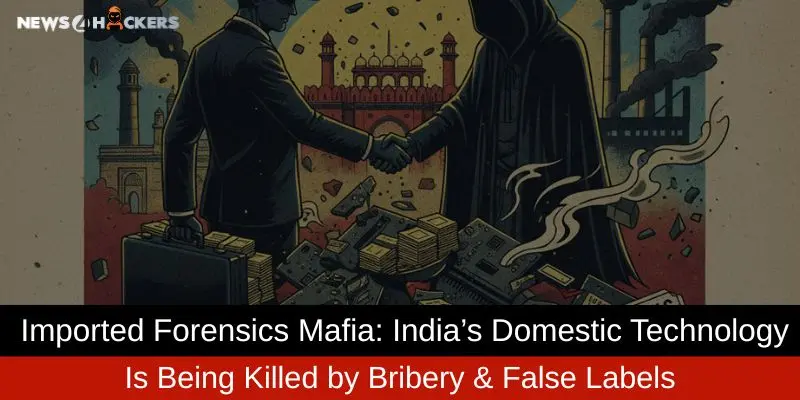
Imported Forensics Mafia: India’s Domestic Technology is Being Killed by Bribery & False Labels
New Delhi, 20 November 2025: Senior professionals in India’s digital forensics community are accusing foreign forensic firms of routinely obstructing authentic Indian breakthroughs through unethical techniques, phony “Make in India” branding, and purported covert transactions with procurement officials.
Despite not adhering to required Indian preference regulations, a few of foreign original equipment manufacturers (OEMs) continue to dominate mobile forensics tenders, according to industry experts with more than 25 years of experience. Any bidder claiming “Make in India” designation under the Public Procurement (Preference to Make in India) Order 2017 (updated 2020 and 2023) must demonstrate at least 50% local value addition for Class-I local suppliers (20% for Class-II) and cannot be a simple assembler or re-brander.
However, in order to falsely qualify as Class-I suppliers, a number of foreign vendors are accused of creating shell corporations, pasting Indian-sounding brand names on imported kits, and submitting counterfeit local-content certificates.

On condition of anonymity, a senior forensic examiner told this correspondent, “These are not Make-in-India products; they are ‘Screwdriver Technology’ operations that import 90–95% of the hardware and software from Israel, the USA, or Europe, slap a Hindi name on the box, and bribe their way into restricted tenders.” According to sources, middlemen and decision-makers are routinely given commissions that range from 15% to 30% of the contract value in order to keep genuine Indian solutions out.
Government regulations are very clear: Although prior experience and technical capability checks are required by Rule 144(xi) of the General Financial Rules and DPIIT guidelines, it is reported that some state police and central agencies waive field trials for preferred foreign-linked vendors, subjecting Indian developers to years-long “proof-of-concept” cycles.
Companies that create chip-off tools, JTAG/ISP solutions, drone forensics modules, and AI-based artifact analysis engines specifically designed for Indian apps (ShareChat, Josh, MX TakaTak, regional language artifacts) that are truly Make-in-India claim they are frequently told their products are “not premium enough”—code, according to insiders, for not paying the anticipated kickbacks.
According to a serving forensic director of a state FSL, “one foreign-linked vendor threatened to blacklist my laboratory from their ‘training programs’ if I continued recommending an Indian tool that outperformed their product in recovering data from Realme and Vivo devices running the latest ColorOS.”

Dependence on foreign forensic tools poses serious national security issues as India strives to create a $1 trillion digital economy by 2030. These worries include backdoors, data breaches to third nations, and intentional incompatibility with Indian firmware changes.
The message from the trenches is clear: true Indian forensic innovation will continue to be suppressed unless investigating agencies and procurement authorities enforce verifiable local content, hold open public trials, and penalize false self-certification (which is punishable under Section 7 of the PPP-MII Order with blacklisting).
The days of scripted rebranding and bogus “premium” imports are over. Digital forensics that are truly Made in India — designed, developed, and produced here — are now available. The political and administrative will to allow it to breathe is the only thing lacking.
About The Author:
Yogesh Naager is a content marketer who specializes in the cybersecurity and B2B space. Besides writing for the News4Hackers blogs, he also writes for brands including Craw Security, Bytecode Security, and NASSCOM.
Read More:
DoorDash Confirms Data Breach Affecting Customers, Couriers, and Merchants
About Author






 English