

A New Cyber Trap “Fake e-Challan Links”: Reasons to Stay Alert
“India is falling into a new kinda trap, ‘Fake e-Challan Links,’ that are not easy to assess and that led to falling for it!”
Cybercrimes involving phony e-challan payment links are on the rise in India, and this trend is indicative of a broader change in the way cybercriminals take advantage of public confidence in digital government.
I’ve noticed a significant rise in the number of folks receiving SMS or WhatsApp messages stating that a traffic challan is pending during the last few months. Links in these messages seem genuine and resemble official government portals. The fraud happens quickly after it is clicked.
This is no longer an instance of straightforward internet dishonesty. Fear, haste, and trust are the main targets of this skillfully planned social engineering effort.
How Does the Fake e-Challan Scam Work?
These frauds employ a pattern that is both predictable and quite successful.
A notification informing the victim that a traffic ticket is outstanding and has to be paid right away in order to avoid fines or legal action. The letter contains a seemingly authentic link that frequently mimics official government URLs.
Once the link is opened:
- A phony e-challan website appears.
- The UI resembles official transportation portals exactly.
- The user is prompted to input vehicle information.
- It asks for payment details, like a card or UPI.
- Malicious software is frequently installed covertly.
Money is taken out of the victim’s account in a matter of minutes.
Nothing about this fraud initially seems odd, which makes it especially perilous.
One Click, A ₹6 Lakh Loss
A man in the Delhi–NCR area recently tried to pay a ₹500 traffic fee after getting an SMS. The procedure was standard, and the website appeared authentic.
However, his credit card was used for several foreign purchases in a matter of minutes. The entire loss was close to ₹6 lakh.
These days, metropolitan areas frequently exhibit this trend.
The terrifying aspect is that victims frequently don’t realize what has happened until they receive bank warnings; by then, the money has already vanished.
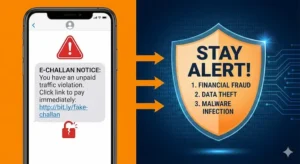
This is psychological manipulation, not hacking.
One crucial point must be grasped:
- These days, the majority of cybercrimes do not entail system hacking.
- They entail manipulating human behavior.
Criminals exploit:
- Fear of repercussions from the law.
- Have faith in the systems of government.
- Absence of digital verification practices.
- Threatening language creates a sense of urgency.
This is referred to as social engineering, and it is currently the most potent tool used by cybercriminals.
Additionally, contemporary fraud networks employ:
- AI-generated templates.
- Cloned government websites.
- International payment gateways.
- Disposable phone numbers.
Because of all of this, tracking down the money is very challenging.
Why Are These Scams Growing So Quickly?
The increase can be attributed to multiple factors:
- Government services are being digitized quickly.
- Heavy reliance on mobile payments.
- Low knowledge of official techniques of verification.
- Blind faith in alerts sent via SMS.
- Fear of fines and legal action.
People believe that anything pertaining to fines from the government or traffic must be real. This psychological shortcut is being used by criminals.
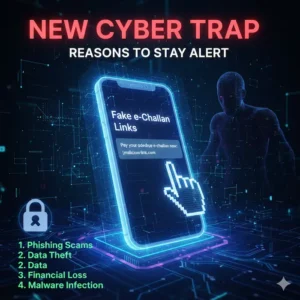
How Can a False e-Challan Message Be Spotted?
In my experience, the following indicators need to prompt suspicion right away:
- Messages requesting immediate payment.
- Links sent using WhatsApp or SMS.
- Website URLs have a few minor spelling corrections.
- Requests for PIN, CVV, or OTP.
- Incorrect formatting or poor grammar.
- Pressure strategies like “last warning.”
There is a straightforward rule that applies:
Payment links are never sent via private messaging by any government agency.
What Should Citizens Keep in Mind?
Today, awareness is more important for cyber safety than technological know-how.
Major losses can be avoided with a few easy habits:
- Only use official government portals to confirm challans.
- Payment links in emails should never be clicked.
- Never divulge card information or OTPs.
- Avoid acting under duress.
- Stop, check, and then continue.
Technology will keep developing. Cybercrime will follow suit.
However, vigilance is still the best defense.
The Last Word
The increase in fraudulent e-challan scams serves as a warning that there is a risk associated with digital convenience. Criminals get smarter as systems get smarter.
Fear is not the answer, but wise prudence is.
Prof. Triveni Singh, Former IPS Officer & Cyber Crime Expert
| “Cybercrime is successful because people trust too easily, not because systems malfunction. The new security is verification.” |
About The Author
Suraj Koli is a content specialist in technical writing about cybersecurity & information security. He has written many amazing articles related to cybersecurity concepts, with the latest trends in cyber awareness and ethical hacking. Find out more about “Him.”
Read More:
A New Android Malware Steals Bank Codes and SMS Using Live Commands
About Author






 English