

Be Cautious of Phishing Attacks Considering Old & New Mistakes: 2026 Needs
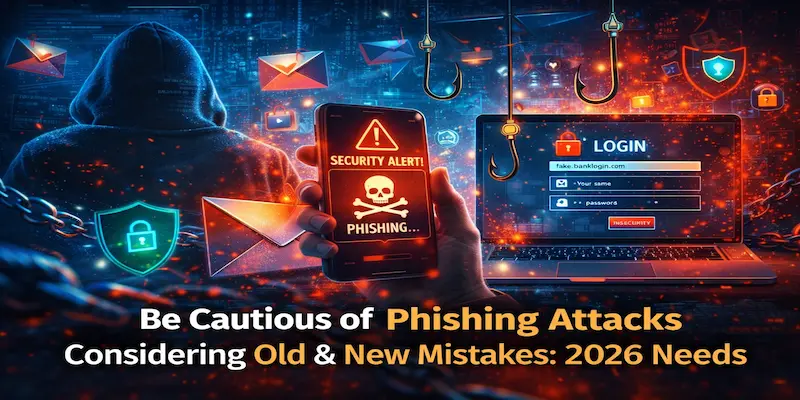
Phishing no longer uses grammatical errors or blatantly fraudulent emails to advertise itself. The attacks of today are sometimes indistinguishable from the communications that people rely on on a daily basis because they are well-crafted, tailored, and timed.
Modern phishing has developed into a professional deception industry that targets human judgment more than computer systems, thanks to artificial intelligence, real-time testing, and comprehensive personal data.
What Is Phishing?
Phishing is a type of cybercrime in which perpetrators pose as reputable people, businesses, or organizations to fool victims into disclosing private information, such as passwords, OTPs, credit card numbers, or bank account information.
These attacks typically come via phone calls, emails, SMS messages, or phony websites that appear authentic.
Common examples include:
- An email saying, “Suspicious activity detected,” purporting to be from your bank. To prevent account suspension, confirm right away.
- A phony income tax or GST notice requesting that you download an attachment.
- A known acquaintance sent a WhatsApp message asking whether you could give ₹5,000 right away. I’ll clarify later.
- Users unintentionally enter their email passwords on a login screen that looks like Google.
Because many phishing attempts are visually identical to authentic correspondence, it is challenging for regular users to detect them.
Types of Phishing
Although phishing is typically associated with email-based fraud, there are other forms of phishing as well:
- Email Phishing: The most typical form. Attackers pose as banks, payment gateways, over-the-top (OTT) platforms, or employers in order to send mass emails.
- Spear Phishing: Customized attacks that make use of compromised databases, LinkedIn profiles, or released data. frequently employed against government officials, lawyers, executives, and journalists.
- Whaling: Top executives (CEOs, CFOs) are the target of a spear phishing subtype that aims to share sensitive documents or approve significant financial transfers.
- Smishing (SMS/WhatsApp Phishing): Messages that pose as delivery updates, utility bills, KYC notifications, or wedding invitations but contain malicious links.
- Vishing (Voice Phishing): Victims are contacted by scammers pretending to be bank employees, police officers, telecom workers, or cybercrime detectives.
- Clone Phishing: A malicious attachment or link is substituted for a legitimate email that the recipient previously received.
- QR Code Phishing: Payment signs, restaurant tables, parking boards, and digital shares all have fraudulent QR codes on them.
- Search Engine Phishing: Search engine advertisements are used to promote fake websites, which show up above real results.
How Phishing Works?
In the following ways, Phishing works:
- Reconnaissance: Attackers obtain phone numbers, email addresses, and personal information from social media, public databases, and data breaches.
- Message Design: Logos, fonts, email signatures, disclaimers, and official language are all designed to look authentic.
- Spoofing & Infrastructure Setup: Mule bank accounts, fake domains, cloned websites, and disposable phone numbers are all ready.
- Triggering Urgency or Emotion: Fear (account barred), greed (refund, prize), authority (bank, police), or empathy (buddy in peril) are all used in messages.
New Techniques Of Phishing Attacks In 2026
The following are the new techniques of phishing attacks in 2026:
1. AI-Generated and Context-Aware Phishing
By imitating genuine communication styles, producing deepfake audio and video, and responding to user behavior at previously unheard-of speeds, AI-generated phishing uses artificial intelligence to create highly personalized, realistic, and extensive scam campaigns that are more difficult to detect than traditional phishing.
These days, attackers employ AI techniques to:
- Create professional, grammatically correct emails.
- Change the tone according to the victim’s job (student, merchant, or employee).
- Copy the communication styles used within your company.
In contrast to previous hoaxes, these messages frequently evade conventional spam filters and look identical to authentic emails.
Example:
An AI-written email urging the recipient to “review updated documents” and mentioning an ongoing project deadline was sent during business hours.
2. Real-Time Phishing (Adversary-in-the-Middle Attacks)
Man-in-the-Middle (MitM) phishing, also known as real-time phishing, is a form of innovative phishing assault that deceives a victim into contacting a proxy server, a server that serves as an intermediary controlled by an attacker.
This makes it possible for attackers to launch much more successful phishing campaigns that can get around the great majority of 2FA techniques now in use. Victims of these assaults are sent to a phony login page that stands in the way of accessing the actual service.
What’s new:
- OTPs and credentials are immediately recorded and transmitted.
- Before the victim knows anything is wrong, attackers log on.
- It is possible to go around multi-factor authentication as well.
The use of this method against cryptocurrency wallets, cloud dashboards, and email accounts is growing.
3. QR Code–Based Phishing (Quishing)
QR code phishing, also known as quishing, is the practice of using malicious QR codes in emails, physical locations, or messages to trick users into visiting phony websites, downloading malware, or disclosing private information like passwords.
It also circumvents traditional email filters by concealing URLs in images, which frequently results in financial fraud or credential theft. These days, QR codes are frequently utilized in:
- Restaurants
- Parking payments
- Utility bills
- Event passes
By inserting malicious QR codes that take visitors to phony login or payment pages, attackers take advantage of this trust.

Why it works:
A QR code cannot be visually examined by users in the same manner as a URL.
4. Deepfake Voice and Video Phishing
Deepfake speech and video phishing are sophisticated forms of social engineering assaults in which cybercriminals employ artificial intelligence (AI) to produce incredibly lifelike synthetic media that imitates the appearance, voice, and mannerisms of trusted people, like a government figure, CEO, or family member. Attackers mimic the following using AI voice synthesis and leaked voice samples:
- Company executives.
- Family members.
- Senior government or police officials.
During what seems to be a real voice or video call, victims are coerced into sending money or disclosing OTPs.
Common use case:
“Emergency” calls for quick financial assistance.
5. Search Engine and Ad-Based Phishing
Ad-based phishing is a type of cyberattack in which hackers alter search engine results (such as Google Ads) to show phony advertisements for reputable services, deceiving consumers into clicking on links that take them to malicious websites that are intended to steal financial information, credentials, or malware.
How it tricks users:
- In search results, fake websites show far higher than real ones.
- URLs appear authentic at first glance.
- “Top result = trusted” is what victims believe.
This approach is widely utilized for cryptocurrency platforms, banking, taxes, and ticket purchases.
6. MFA Fatigue and Notification Bombing
MFA fatigue, sometimes referred to as MFA bombing or push spamming, is a social engineering cyberattack in which an attacker continually sends multi-factor authentication (MFA) push notifications to the target’s device after gaining the user’s credentials.
The victim is inundated with authentication prompts while the attacker continually initiates login attempts. In the end, the user:
- Accepts a single prompt out of perplexity or irritation.
- Believes there is a system error.
Attackers get rapid access after approval.
7. Business Email Compromise (BEC) 2.0
Business Email Compromise (BEC) is a sophisticated cyberattack in which criminals use email to pose as trusted people (such as CEOs or vendors) to deceive employees into making fraudulent wire transfers, disclosing sensitive information, or altering payment details.
By taking advantage of human trust rather than sophisticated malware, BEC causes enormous financial losses.
These days, BEC attacks consist of:
- Long-term observation of internal correspondence.
- Timing communications to correspond with actual payments or bills.
- Little modifications to the payment instructions or bank details.
There is only manipulation, not a malicious link.
False KYC, Policy Updates, and Compliance
Attackers take advantage of regulatory settings by sending:
- Warnings of “mandatory KYC update.”
- “Policy violation” notifications.
- Demands for “account re-verification.”
These communications take advantage of people’s fear of fines, account suspension, or legal action.
Old Errors That Continue to Allow Phishing
Malicious actors can take advantage of confidence and get around security safeguards through phishing assaults, which are made possible by a mix of human error and institutional oversights. Inadequate security procedures, a lack of training, and a failure to identify warning indicators are the most frequent errors.
Typical Human Errors
The following are some of the typical human errors:
- Falling for Urgency and Fear Tactics: Attackers fabricate a sense of urgency (such as “account will be suspended” or “immediate payment required”) to coerce victims into acting without considering or confirming the request.
- Trusting the Sender’s Appearance: When a message seems to come from a reliable source, like a bank, government organization, or senior executive, users are more likely to believe it (whaling attacks). They might not carefully check the domain name or email address for minute typos.
- Clicking Suspicious Links/ Attachments: The most frequent way that malware or credential harvesting enters the system is through clicking on links or opening unexpected attachments.
Precautions like refusing to enable macros in unexpected documents or hovering over a link to verify the destination URL are frequently disregarded.
- Sharing Sensitive Information: Giving sensitive information such as passwords, credit card numbers, or MFA codes by phone or email is a grave error because reputable businesses hardly ever ask for such information via insecure means.
- Ignoring Red Flags: Scams are more likely to succeed when common phishing flags like poor grammar, generic greetings, strange phrasing, or unattractive design are ignored.
- Underestimating AI-Enhanced Threats: It is incorrect to rely just on antiquated warning signs, such as poor grammar, as contemporary AI systems are capable of producing flawlessly crafted, highly customized phishing communications that are more difficult to identify.
Organizational and Technical Mistakes
The following are some of the organizational and technical mistakes:
- Lack of Comprehensive Security Training: One major concern is that not all staff have received proper security awareness training. Training frequently concentrates solely on email, disregarding other platforms where phishing happens, such as social media, SMS (smishing), phone calls (vishing), and live meeting platforms.
- Insufficient Email Security Controls: It is insufficient to rely only on simple spam filters. Sandboxing for attachments, URL screening, and sophisticated email security solutions are essential defenses but are frequently absent.
- Weak Password Practices and No MFA: In the event that one account is compromised, credential stuffing is made simple for attackers by using weak or reused passwords across several accounts. Accounts are exposed when Multi-Factor Authentication (MFA) is not implemented or when MFA is used in an insecure manner.
- Neglecting Software Updates: Once a user clicks on a malicious link or opens an attachment, attackers can use known vulnerabilities in outdated operating systems and programs to install malware.
- Poor Incident Response Planning: The damage can be exacerbated by not having a well-defined, written plan for what to do in the event of a phishing attempt.
What Cybersecurity Experts Emphasize?
Cybersecurity experts emphasize the following things:
1. Phishing Is Now a Behavioral Risk, Not Just a Technical One
Security professionals note that even with security measures in place, the majority of successful phishing instances still happen. This is due to the fact that phishing attempts are designed to:
- Arrive while you’re stressed or distracted.
- Simulate normal, authentic interactions.
- Take advantage of trust, authority, and urgency.
According to experts, the main attack surface is now the user rather than the system.
2. AI Has Raised the Baseline Quality of Scams
Experts point out that several classic phishing warning indicators have been removed by artificial intelligence:
- Most uncomfortable language and poor grammar have been eliminated.
- Messages are customized for particular positions, sectors, and geographical areas.
- Emails are now formatted, timed, and have a business tone.
Attackers may create hundreds of different variants of a message, test which ones succeed, and improve them nearly immediately thanks to AI. Because of this, even cautious users could miss clear warning signs.
3. Attackers Test Messages in Real Time and Adapt Quickly
Modern phishing attempts are constantly optimized, in contrast to older tactics that were static for weeks. Today’s cybercrime groups:
- Keep track of the links that are ignored and those that are clicked.
- Within hours, change the sender names, subject lines, or wording.
- Adapt strategies in response to user reactions and defenses.
According to experts, this quick adaptation is similar to digital marketing tactics, making phishing efforts more successful and durable.
4. The Average User Now Faces Professional-Grade Deception
Security experts caution that modern phishing schemes frequently resemble:
- Internal corporate emails.
- Legal or compliance notices.
- Customer support interactions.
Instead of focusing on numbers, attackers devote time and resources to establishing credibility. This implies:
- Higher success rates with fewer messages.
- Each compromised account does more harm.
- Increased difficulty in differentiating between real and fraudulent.
In actuality, consumers are now interacting with organized, specialized fraud networks rather than unskilled con artists.
What Do Experts Always Suggest?
The following are some recommendations from experts:
1. Slow Down Decision-Making
Experts stress that the attacker’s greatest asset is speed. The majority of phishing attempts are successful because victims take quick action. Even a minute of deliberate slowing down can reveal contradictions or raise questions. The emotional momentum that phishing depends on is broken by pausing.
2. Verify Every Unexpected Request
Experts emphasize the need for independent verification:
- Don’t respond to the same message twice.
- The contact information in the request should not be used.
Always double-check using reputable coworkers, known phone numbers, or official apps.
Consider Urgency as a Cautionary Sign
Experts encourage consumers to go against their gut feelings:
- A message should cause more caution rather than quicker action if it causes anxiety or pressure.
Urgent language is frequently the best sign of manipulation rather than evidence of validity.
Develop Household and Institutional Verification Practices
Security experts argue that phishing avoidance is more effective when it is a regular practice rather than a one-time instruction. Among the suggested practices are:
- Workplaces should have clear verification procedures.
- Family guidelines for OTP sharing and cash requests.
- “No urgent request bypasses verification” is a common belief.
What Should You Do If You’ve Already Become a Victim?
If you ever become a victim, you need to do the following tasks:
- Immediate Action (First 10 Minutes)
- Cut off mobile data and Wi-Fi internet access.
- Use a clean device to change your passwords.
- If necessary, give your bank a call and ask for an account freeze.
- Within 1 Hour
- Block net banking, UPI, and credit/debit cards.
- Remove unknown installations and app permissions.
- Log out of every session that is open.
- Within 24 Hours
- Use the cybercrime site at www.cybercrime.gov.in to file a complaint.
- If your work accounts are impacted, let your employer know.
- Keep an eye on bank statements and credit reports.
- How to Collect Evidence?
- Links, screenshots, and phony websites.
- Keep the headers of emails intact.
- Note phone numbers and call details.
- Save SMS alerts and transaction receipts.
About The Author
Suraj Koli is a content specialist in technical writing about cybersecurity & information security. He has written many amazing articles related to cybersecurity concepts, with the latest trends in cyber awareness and ethical hacking. Find out more about “Him.”
Read More:
Future Crime Summit 2026: India’s Biggest Cybercrime Conference
About Author






 English