

Scammers Take Advantage of Screen-Sharing Apps to Steal Bank Accounts and Smartphones
Scammers Take Advantage of Screen-Sharing Apps to Steal Bank Accounts and Smartphones
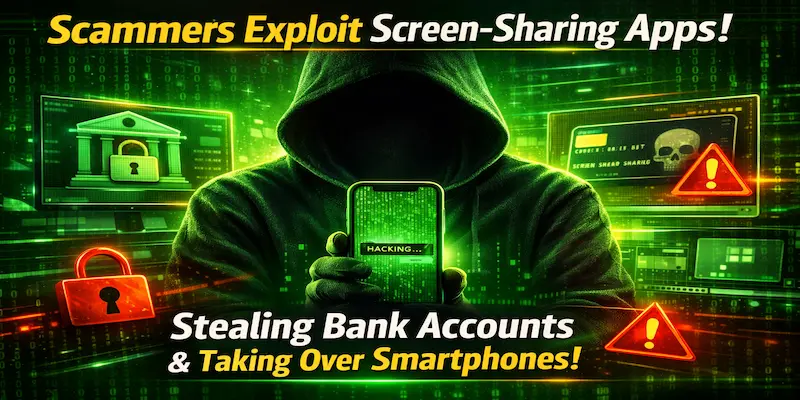
A common call is turning into an expensive trap in India and other smartphone-heavy nations. Scammers are tricking people into installing trustworthy remote-access apps by pretending to be banks, government agencies, or customer service representatives. They then silently watch as identities and money disappear.

An Official-Sounding Call
Usually, there is no drama at the start of the exchange. Someone posing as a representative of a reputable organization, such as a bank, customer service desk, or government agency, calls or texts you. The tone is composed and authoritative, regardless of the reason—an urgent KYC verification, a delayed refund, a bank account issue, etc.
The request that follows is presented as standard technical support. The caller requests that the smartphone user download a remote-access program, such as AnyDesk, TeamViewer, or QuickSupport, in order to “fix” the problem. These apps are promoted as providing genuine technical support and troubleshooting, and they are widely accessible on official app stores.
After installation, the user is prompted to either allow full-screen permissions or provide an access code. The phone’s control essentially switches hands at that point.
How Remote-Access Apps Become a Weapon
One device can view or operate another in real time with the use of remote-access software. Technology enables experts to resolve issues in corporate IT settings without having to be physically present. The same characteristics provide instant exposure in scam calls.
Scammers can view one-time passwords and transaction warnings as they appear, watch banking apps in use, and see passwords, PINs, and personal information being typed if they are granted access. Each swipe, tap, and notification is displayed.
The danger increases rapidly. Remote access can result in illicit transactions, account empties, and the exploitation of personal identifying information in a matter of minutes. The environment in which the apps are used transforms them into effective surveillance tools, even though the apps themselves are not harmful.
Warnings That Are Increasingly Explicit
In recent months, smartphone users have received increasingly clear security advisories. They highlight a straightforward principle: no reputable bank, government agency, or customer support representative will ever request that a user install a remote-access application over the phone, divulge passwords or one-time passcodes, or allow full-screen access in order to “fix” a problem.
Guidance has emphasized moderation and tidying up, especially for Android users. Users are recommended to remove installed remote-access programs right away if they are not frequently used. It is advised to remove the application as soon as the work is over if installation is necessary for a valid task.
Above all, regardless of how legitimate the request may seem, users are advised never to give screen access or app-generated tokens to unidentified callers.
The Unique Point of Failure of a Smartphone
These days, smartphones serve as identity vaults, offices, and wallets. They consolidate previously disparate assets into a single device by storing bank accounts, private communications, work files, and authentication tools.
This focus has increased the impact of minor errors in judgment. A stranger can view and take control of almost every part of a person’s digital life if they download the incorrect app, click on an unknown link, or believe the wrong call.
Because users are becoming more dependent on their phones for sensitive tasks, scammers have evolved and are now taking advantage of popular remote-access programs, not because the software is defective. One phone call at a time, the technology that makes remote assistance and convenience possible has turned into a means of identity theft and financial crime in the wrong hands.
About The Author:
Yogesh Naager is a content marketer who specializes in the cybersecurity and B2B space. Besides writing for the News4Hackers blogs, he also writes for brands including Craw Security, Bytecode Security, and NASSCOM.
Read More:
North Korean Hackers Attack Devs via Malicious vs Code Projects
About Author






 English