

NIST Breakthrough: Single Photons Produced on a Silicon Chip for Quantum Computing
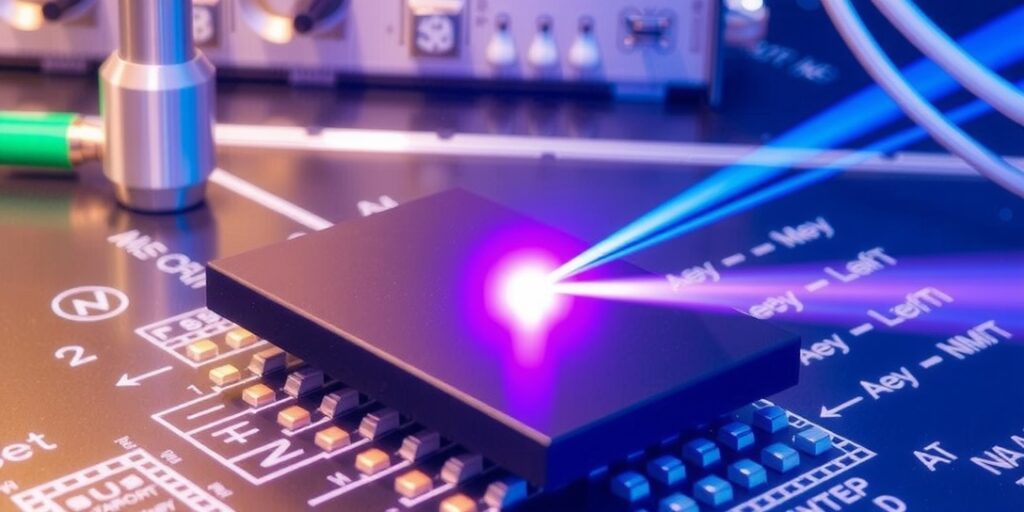
NIST Breakthrough in Quantum Computing
Scientists at the National Institute of Standards and Technology (NIST) have achieved a significant breakthrough in the field of quantum computing, successfully developing a chip that can reliably produce single photons on demand.
Implications for Quantum Key Distribution
This innovation has major implications for the future of quantum key distribution (QKD), a method of secure communication that relies on the principles of quantum mechanics to encode and decode messages.
The Threat of Quantum Computers
The advent of quantum computers poses a significant threat to current encryption methods, as they will be able to rapidly factor large numbers using Shor’s algorithm, rendering many forms of encryption obsolete.
However, NIST has been working on developing post-quantum cryptography (PQC) algorithms to mitigate this threat. While these algorithms are theoretically secure, they are not provably secure, as any mathematical solution can be potentially broken with enough computational power.
Quantum Key Distribution
QKD offers a provably secure method of key distribution, as any attempt to intercept the key exchange will disrupt the message and alert the receiver.
This is because QKD relies on the principles of quantum mechanics, where the act of observing a quantum particle can disturb its state. By harnessing this principle, QKD can provide a secure method of communication that is resistant to eavesdropping.
Challenges in QKD
However, current implementations of QKD are not without their challenges. The process of generating single photons is not very efficient, and the use of amplifiers to extend the distance over which the photons can travel can compromise the security of the system.
Furthermore, the cost of implementing QKD can be prohibitively expensive, making it accessible only to organizations with highly sensitive information, such as military and government agencies.
NIST’s Breakthrough
NIST’s breakthrough in producing single photons on demand addresses many of these challenges. By using quantum dots, which emit a single photon when hit by a carefully shaped laser pulse, NIST has been able to achieve near-perfect efficiency in generating single photons.
Implications of the Breakthrough
The implications of this breakthrough are significant, as it has the potential to provide a secure method of communication that is resistant to the threat of quantum computers.
With the ability to produce single photons on demand, QKD can be used to provide secure communication for a wide range of applications, from government and military communications to financial transactions and sensitive business data.
Implications for Quantum Computing
In addition to its applications in QKD, NIST’s breakthrough also has implications for the development of quantum computers themselves. Some quantum computing companies use photons as qubits, and the ability to produce single photons on demand could potentially be used to improve the performance of these systems.
Conclusion
Overall, NIST’s breakthrough in producing single photons on demand is a significant step forward in the development of QKD and has major implications for the future of secure communication.
As the threat of quantum computers continues to grow, the need for secure methods of communication will become increasingly important, and NIST’s breakthrough has the potential to play a major role in addressing this need.

About Author








 English