

EU and UK Blacklist Russian Cyber Actors Over Cyber Attacks Targeting Europe
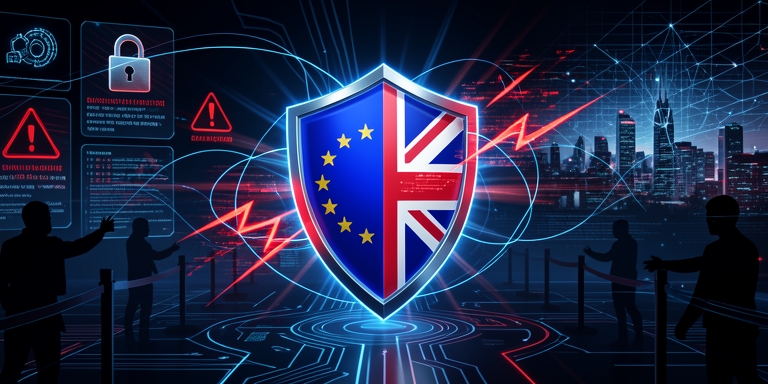
EU and UK impose sanctions on Russian cyber actors linked to destabilization efforts
EU and UK Sanctions Details
The European Union and United Kingdom have implemented coordinated sanctions targeting multiple Russian individuals and organizations, citing their role in orchestrating a cyber infrastructure aimed at undermining European stability and international alliances. The UK designated 24 entities and individuals, while the EU applied restrictions to nine individuals and four organizations. The measures encompass cybercriminals, self-styled hacktivists, and private firms associated with Russia, including those operating under its direction or control, which have engaged in or facilitated malicious activities.
Condemnation of Russian Actions
The EU Council emphasized condemnation of Russia’s actions, highlighting the targeting of public services and critical infrastructure, which have led to operational disruptions and financial harm. The EU Council attributed several cyber espionage and sabotage operations to the 16th Centre of Russia’s Federal Security Service (FSB), alleging that the unit directed threat groups such as Turla to infiltrate government networks and critical infrastructure across Europe.
Cyber Espionage and Sabotage Operations
This includes attacks on energy systems in Poland, where the 16th Centre allegedly targeted combined heat and power plants. On December 29, 2025, a sophisticated cyberattack deployed previously unidentified data-wiping malware against over 30 wind and solar farms, a combined heat and power plant, and a manufacturing facility in Poland. Although the attack did not succeed in halting energy production or heating supply, it underscored the evolving threat landscape.
Recent Cyberattacks in Poland
More recently, Polish authorities thwarted a cyberattack targeting the IT systems of the National Centre for Nuclear Research, a key nuclear research institution. The EU Council stated that the 16th Centre has systematically targeted government networks and critical infrastructure in France, Germany, Poland, Cyprus, the Netherlands, Austria, Slovakia, Romania, and Finland over an extended period.
UK Foreign Secretary’s Statement
UK Foreign Secretary Yvette Cooper criticized Russia’s actions, stating that the state has resorted to increasingly aggressive tactics, including targeting Poland’s energy grid during winter, to erode European security. The UK sanctions also address individuals connected to Lumma Stealer, a credential-harvesting malware used to extract sensitive data from compromised devices.
Lumma Stealer and Cyber Espionage
The UK government reported that Russia has leveraged stolen credentials from Lumma Stealer to conduct cyber espionage campaigns. The National Crime Agency identified at least 2,100 UK victims affected by the malware within the past six months.
EU’s Broader Cyber Sanctions
The EU’s sanctions represent the most extensive individual designations since Russia’s 2022 full-scale invasion, including the largest cyber-focused sanctions package to date. These measures follow earlier EU actions in March, when three Chinese and Iranian companies, along with two individuals, were sanctioned for cyberattacks against EU member states and partners.
NSA Guidance and International Cooperation
Separately, the National Security Agency (NSA) and its collaborators issued guidance to safeguard routers against cyber activities linked to the FSB’s 16th Centre. The actions reflect a broader effort to counter persistent cyber threats and protect critical systems across Europe. The EU and UK continue to emphasize the importance of international cooperation in addressing state-sponsored cyber operations and mitigating their impact on global security.
“The EU Council emphasized condemnation of Russia’s actions, highlighting the targeting of public services and critical infrastructure, which have led to operational disruptions and financial harm.”
“UK Foreign Secretary Yvette Cooper criticized Russia’s actions, stating that the state has resorted to increasingly aggressive tactics, including targeting Poland’s energy grid during winter, to erode European security.”

About Author






 English