

Cyberattack at Delhi Airport: Investigation Launched After Major AMSS System Malfunction
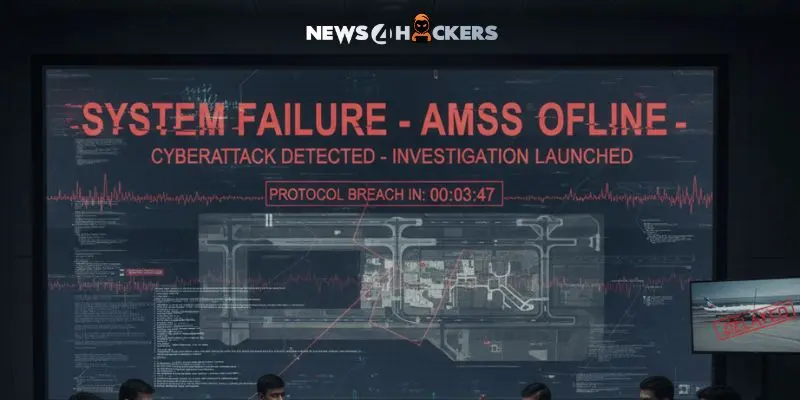
Cyberattack at Delhi Airport: Investigation Launched After Major AMSS System Malfunction
New Delhi: The vulnerability of India’s aviation automation backbone was shown after a rare system failure at Delhi’s Indira Gandhi International Airport delayed air operations for almost an entire day. The incident has sparked serious concerns about cyber readiness and infrastructure supervision as officials look into whether the Automatic Message Switching System failure was caused by a technical issue or something more malicious.
When the Heart of Air Traffic Fell Silent
One of the world’s busiest airports operated in manual mode for more than twelve hours on Friday. At Delhi’s Indira Gandhi International Airport, flight controllers were used to seeing screens flash real-time data on aircraft movements, but all of a sudden, they were taking handwritten notes. Around nine in the morning, the Automatic Message Switching System (AMSS), a computerized network that distributes flight plans, permissions, and weather updates throughout India’s aviation grid, crashed.

At least 20 planes had been canceled and over 800 had been delayed by the time engineers fixed it at 9:30 p.m. As traffic spread from Delhi to Mumbai, Bhopal, Chandigarh, and Amritsar, passengers stood in line at boarding gates for hours.
| “It was like stepping back two decades,” said one Air Traffic Control (ATC) official. “Everything had to be done by hand.” |
Later that night, the Airports Authority of India (AAI) verified that the system was “active and working properly.” However, the questioning had only just begun, and the harm had already been done.
Inside the System That Keeps the Skies in Sync
The digital hub of Indian aviation is the AMSS. This network is used by all flight plans, including their route, altitude, fuel, and destination. It automatically updates in real time as the weather or routes change, sending information to ATC towers, other airports, and concerned airlines.

The system processes thousands of communications every hour on a typical day, including airspace warnings, delays or diversions, minute-by-minute fuel adjustments, and when a flight takes off or lands.
| “It’s what keeps every aircraft in Indian airspace coordinated,” explained a senior AAI engineer. “If AMSS stops, you’re blind.” |
That’s precisely what took place on Friday. Controllers had to manually relay each clearance since automatic messages were stopped. Arrivals were delayed, departures were rescheduled, and clearances were delayed as the slowdown spread across the entire system. According to tracking data from FlightRadar24, the outcome was an average delay of fifty minutes for all planes.

Warnings Ignored, and the Shadow of a Cyber Threat
According to ATC sources, the failure was “unprecedented” in both its duration and its type. Since installation, the system had never had a prolonged blackout. A deeper cause is suspected by several officials. The entire network was frozen due to a problem that started at one terminal; they saw that this failure pattern was consistent with coordinated cyber intervention.
In order to determine if the outage could have been caused outside, the central government called a high-level meeting in the National Security Advisor’s office late on Friday, inviting representatives from AAI, airport security, and cyber agencies. Although not verified, the likelihood of a hack is still being looked into.
Previous warnings added to the anxiety. According to reports, in July, the ATC Guild of India notified AAI of “deficiencies in the airport’s automation system” and asked for immediate improvements.
| “We had raised red flags about vulnerabilities, but no action was taken,” an ATC official said. |
A Wake-Up Call for Aviation Infrastructure
More than just a technological annoyance, Friday’s glitch revealed the weaknesses of India’s quickly digital aviation industry. The AMSS was developed as a symbol of modernization to replace laborious manual processes with smooth automation. However, the same reliance on digital accuracy has given rise to a new type of vulnerability that may bring down an entire network with a single point of failure.
Officials maintain that AMSS is constantly being improved, and the AAI has promised improvements. However, the incident served as a sobering reminder that even the most sophisticated systems may malfunction, leaving passengers stuck in terminals and controllers manually rewriting flight clearances.
| “Technology is the backbone of aviation,” said one senior air traffic officer. “But when the spine bends, everything above it shakes.” |
About The Author:
Yogesh Naager is a content marketer who specializes in the cybersecurity and B2B space. Besides writing for the News4Hackers blogs, he also writes for brands including Craw Security, Bytecode Security, and NASSCOM.
Read More:
Microsoft Finds a “Whisper Leak” Attack That Detects AI Chat Topics in Encrypted Traffic
About Author







 English