

Cyberattack Hit France’s Postal Service: Claimed By Pro-Russian Hackers
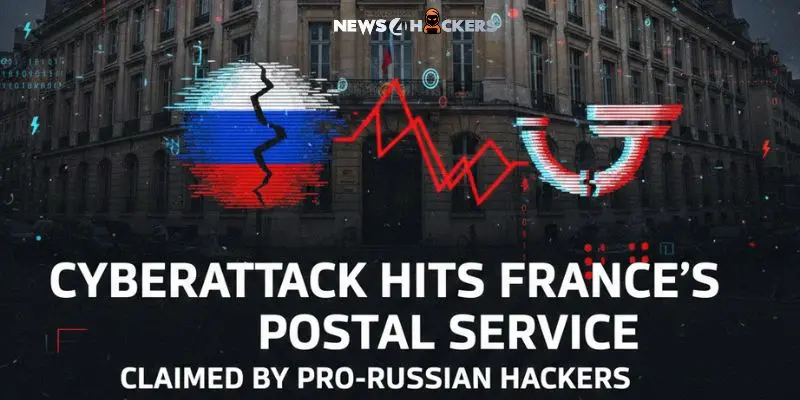
“A massive cyberattack hit France’s Postal Services, and Pro-Russian Hackers Took the Responsibility for it.”
Investigators linked the interruption to a well-known area of Europe’s shadow war, where cyberattacks, sabotage, and disinformation have become standard instruments of geopolitical pressure, as France’s postal system came to a complete stop amid the holiday rush.
A Critical Cyber Disruption
La Poste, France’s national postal service, had an abrupt and widespread digital meltdown in the days leading up to Christmas. After being overloaded with traffic, core computer systems became unresponsive, making it impossible for consumers to make online payments through the company’s bank, La Banque Postale, and for postal employees to trace packages.
The impact was enhanced by the timing. With over 200,000 workers and volumes at their highest over the holiday season, even a minor outage had an impact on both families and logistics networks.
Officials
| Days after the first breach was discovered, the issues continued. |
A pro-Russian hacker group called NoName057(16) quickly took credit for the event, adding it to an increasing number of cyberattacks that target European organizations that aid Ukraine.
An Attack Pattern Throughout Europe
The postal service attack is seen by French officials as a component of a larger campaign rather than an isolated act. Western countries have accused Moscow of planning or supporting a variety of hostile acts around Europe since Russia invaded Ukraine in February 2022.
These crimes include burning at warehouses, destruction of railroads, and digital intrusions into government and business systems.
French Authorities
| The Justice Ministry’s and several local authorities’ websites have been targeted by the same hacking organization in the past. In addition to France, the gang has been blamed for attacks on media outlets, government institutions, and companies in Ukraine, Poland, Sweden, and Germany. |
European Intelligence Officials
| These activities are intended to inflict friction rather than long-term harm, upsetting daily life, undermining trust in governmental institutions, and putting the fortitude of Kyiv-aligned states to the test. |
Laurent Nuñez, Interior Minister, French Media
| Only a few days after France revealed a different hack on the Interior Ministry, which is in charge of national security, the postal service was compromised. Sensitive documents and police records were obtained by a suspected hacker in that instance. |
Examinations and the Attribution Issue
Following the hackers’ public declaration, the investigation into the postal attack has been taken up by France’s domestic intelligence agency, DGSI. Although officials admit that patterns of intervention “very often come from the same country,” a statement commonly interpreted as a reference to Russia, prosecutors have refrained from explicitly assigning blame to a foreign state.
Prosecutors recently acknowledged that France’s intelligence agencies are investigating a planned cyber operation involving software that may have allowed remote control of a major passenger ferry in a separate case, highlighting official concern.
Authorities have not disclosed the nation in question, but a Latvian crew member is being detained on suspicion of acting for a foreign state.
The Front Line of Digital Policing
Law enforcement in Europe has previously made an effort to interfere with these networks. Operation Eastwood, which was coordinated by police from 12 nations in July, resulted in the shutdown of over 100 servers globally, the arrest of individuals in France and Spain, and the issuance of warrants for others, including a number of Russian nationals. The endeavor merely had a short-term impact.
Officials
| The gang resumed activities in a matter of days, underscoring the challenge of dissolving loosely organized cyber collectives that operate across borders and governments. |
About The Author
Suraj Koli is a content specialist in technical writing about cybersecurity & information security. He has written many amazing articles related to cybersecurity concepts, with the latest trends in cyber awareness and ethical hacking. Find out more about “Him.”
Read More:
Google Allows Users to Change @gmail.com Email Address Now
About Author



 English