

“Downloads” Folder Became a Cybercriminals’ Weapon: System Risk at One Click
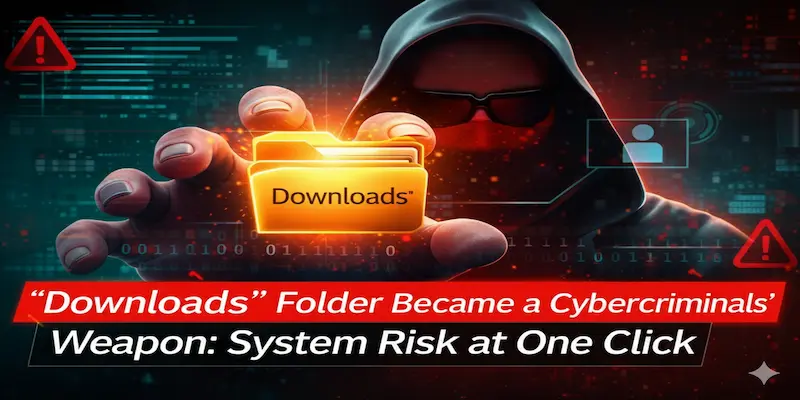
“Recently, a single click became a risk for the system being at risk. Let’s find out more about it!”
The nature of cyberattacks has drastically changed in a fast-digitalizing industry. The most hazardous and successful attacks now start with the user’s unaware permission, whereas in the past, hackers focused on exploiting technical flaws to gain access to systems.
Cybersecurity Experts
| Cybercriminals now use the downloads folder on any device as their most dependable and simple port of entry.
Cybercrime is no longer a collection of individual instances. Attackers now seek to take advantage of human behavior, haste, and digital ignorance rather than breaking robust technical defenses in this well-planned, professional, and well-organized ecosystem. This change explains why conventional security measures like firewalls and antivirus software are becoming less and less effective. |
What makes the downloads folder the weakest link?
According to cybersecurity evaluations, a significant percentage of malware now propagates via files that users willingly download. These consist of office documents, media files, software installations, invoices, and update packages.
These files seem totally secure at first, but when they are opened, they can start spyware, ransomware, and programs that steal credentials.
Trojanized documents, false update notices, and phony installers are increasingly being used by cybercriminals to trick consumers. A backdoor is formed in the system the instant a file is opened, giving access to private information, bank account details, and, in certain situations, total network control.
Cybercrime follows an “industry model.”
Cybercrime is increasingly seen by the cybersecurity community as functioning according to a complete industry model. Malware is extensively tested, continuously improved, and then widely disseminated. Criminals may now conduct large-scale attacks at little cost because of models like “ransomware-as-a-service,” which have reduced entry barriers.
These days, it’s not uncommon to find phony websites, fake software updates, and even harmful downloads masquerading as productivity tools. Individual users are no longer the only ones affected; government agencies, banking institutions, and other delicate organizations are also affected.
Why does India face a higher risk?
The problem is especially severe in India because the number of new digital users is growing so quickly. Because “bring your own device” (BYOD) is so popular, people frequently use the same laptop or smartphone for both personal and work-related tasks.
Experts caution that once a trojanized file gets into a personal device, it may quickly move to government platforms, banking systems, and corporate networks, increasing the dangers of financial fraud, data breaches, and national security threats.
Deepfakes and AI make the threat more serious
The panorama of cyber threats has become even more complex due to artificial intelligence (AI). These days, phishing emails and communications are more difficult to identify because they use precise wording, a genuine tone, and references to actual initiatives.
Financial approvals and administrative decisions are being influenced by the use of deepfake technology to create phony video conversations and voices.
Future Crime Research Foundation
| Nowadays, a single user click is more important in cyberattacks than software flaws. The foundation emphasizes that behavior, awareness, and attention are now more important in the fight for digital security than technology. |
What are the opinions of experts?
The majority of current security frameworks, according to experts connected to the Centre for Police Technology, were created for outdated threat models. They claim that real-time threat intelligence and advanced analytics are now essential in the face of AI-driven, fast, and multi-layered cyberattacks.
Triveni Singh, a prominent cybercrime specialist and former IPS officer, characterizes contemporary cybercrime as psychological warfare.
Triveni Singh, Former IPS Officer, Cybercrime Expert
| “These days, hackers target individuals rather than systems. Users are tricked into performing things that no purely technical attack could do by taking advantage of their anxiety, sense of urgency, and misguided faith.” |
The path ahead
Experts concur that content scanning is no longer adequate on its own. It is now crucial to continuously monitor user and system behavior, including anomalous logins, dubious downloads, and departures from typical activity patterns.
It is now essential to combine threat intelligence, data security, and identity management into a single framework.
They emphasize that cybersecurity needs to be seen as an investment rather than a cost. The first line of defense in today’s digital world is the file that a user decides to download and open, not a firewall.
The best defenses against an increasingly complex cyber threat scenario continue to be vigilance, awareness, and disciplined digital habits.
About The Author
Suraj Koli is a content specialist in technical writing about cybersecurity & information security. He has written many amazing articles related to cybersecurity concepts, with the latest trends in cyber awareness and ethical hacking. Find out more about “Him.”
Read More:
High Financial Frauds Across India Caused Loss of ₹19,812 Crore in 2025
About Author









 English