

First UN Anti-Cybercrime Pact Staged in Hanoi in 20 Years
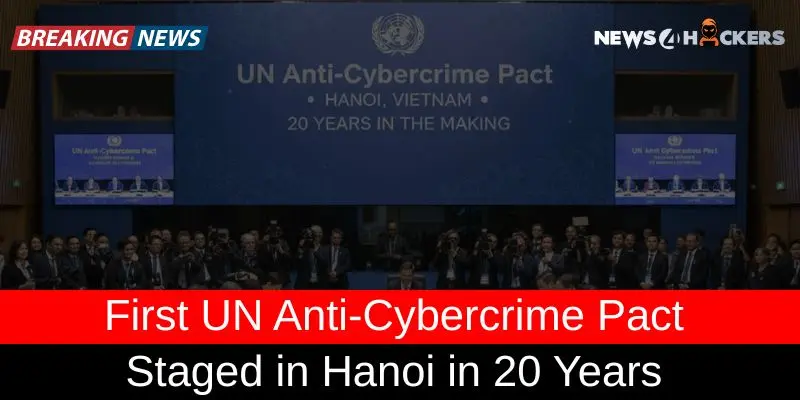
“Cybersecurity has turned a new leaf in Hanoi, because it became the stage for the first UN anti-cybercrime pact.”
Vietnam will host the signing of the United Nations Convention against Cybercrime, the first worldwide anti-crime pact in 20 years, solidifying its expanding role in global digital governance as cyberattacks increase and risks to digital economies grow.
A World Record With Hanoi at Its Foundation
In what UN authorities call a “crucial step forward” in the global community’s efforts to combat online criminality, the Hanoi Convention, also known as the UN Convention against Cybercrime, will be signed in the capital of Vietnam on October 25–26.
On December 24, 2024, the UN General Assembly formally adopted the convention, making it the first significant global anti-crime agreement since the Palermo Convention on Transnational Organized Crime in 2000.
After eight rounds of negotiations and five intersessional sessions between February 2022 and August 2024, the most extensive international legal framework to combat cyber threats was finally created.
In addition to 38 expert workshops and more than 20 exposition booths examining cyber governance, data protection, and cross-border collaboration, the two-day event in Hanoi will feature eight high-level discussions co-hosted by Vietnamese ministries and the UNODC.

Vietnam’s Growing Cyberdiplomacy Role
Vietnam’s hosting of the Hanoi Convention is a testament to years of multilateral involvement and investment in cybersecurity governance.
Đặng Hoàng Giang, Foreign Affairs Deputy Minister, Permanent Representative, Vietnam, UN, 2022 to 2025
| Under the State President’s direction, the nation had “actively and comprehensively” engaged in all rounds of negotiations, coordinating the work of the Ministry of Foreign Affairs and the Ministry of Public Security.
In order to ensure that the treaty strikes a balance between international cooperation and home legal frameworks, Vietnam’s delegation fought for the inclusion of principles that emphasize national sovereignty, independence, and non-interference in domestic issues.
“Giang stated that the final language exhibits “a harmony between national interests and global standards,” adding that Vietnam’s beneficial contributions were widely acknowledged.” |
The convention is the first international legal document to address crimes like online child sexual abuse, money laundering, and complex digital scams in almost two decades, and its acceptance represents “a major victory for multilateralism,” according to UNODC Executive Director Ghada Waly.
An Increase in Cyberthreats
The treaty was signed at a time when cybercrime was alarmingly on the rise worldwide. Millions of cyberattacks happen every day, and the UN estimates that the annual global cost of cyberattacks currently surpasses $8 trillion (₹7.06 lakh crores).
859,532 complaints of suspected cyber offenses were recorded in the FBI’s 2024 Internet Crime Report, with losses exceeding $16 billion (₹14,032 crores), a 33 % rise from the year before.
Over 11,000 cyber events were reported by the EU Agency for Cybersecurity (ENISA) throughout Europe, including ransomware and DDoS attacks that caused disruptions to public infrastructure, schools, and hospitals.
Vietnam Officials
| “Increasingly complex in scale, nature, and impact” is how the danger has evolved. |
Lê Xuân Minh, Major General, Director, Cybersecurity and High-Tech Crime Prevention Department, Public Security Ministry
| Just last year, more than 100,000 cyber-related incidents were reported. He went on to say that criminal activities that target financial institutions and national systems are changing from individual attacks to well-planned, international networks. |
Hanoi’s need for international collaboration, reciprocal legal aid, and cross-jurisdictional exchange of electronic evidence, all essential components of the new convention has been strengthened by this context.

Creating Technical and Legal Foundations
Cyber offenses like unauthorized access, system tampering, online exploitation, and the laundering of digital revenues are defined in the 71 articles and nine chapters that make up the Hanoi Convention.
In addition to methods for cooperative investigation, capacity-building, and awareness-raising among member governments, it describes jurisdictional processes, standards for gathering evidence, and procedural safeguards.
At the same time, Vietnam’s internal structure has changed. The 2020 National Digital Transformation Programme incorporated cybersecurity into the nation’s larger digital agenda, while the 2018 Law on Cybersecurity created fundamental safeguards for both individual rights and national security in cyberspace.
Technical standards for data transmission, storage, and incident response have been reinforced by new personal data protection laws. The nation now regularly holds cyber exercises, encourages digital literacy, and has improved public-private sector collaboration.
Additionally, it keeps up tight coordination with international law enforcement organizations and ASEAN partners, exchanging best practices and encouraging reciprocal legal assistance.
A Digital Future That Is Shared
As evidence that a mid-sized country can assist in guiding world governance in an area that was previously dominated by major powers, Vietnam views the Hanoi Convention as both a diplomatic milestone and a sign of strategic maturity.
In an address to international leaders before the event, President Lương Cường referred to cyberspace as “a shared asset of humanity” and urged nations to respect solidarity and the rule of law in the digital sphere.
As the convention is being signed, it gives more than just a new legal tool; it acknowledges that no country can combat cybercrime on its own. One article, one concept, and one network at a time, international diplomacy in Hanoi is embracing digital reality.
About The Author
Suraj Koli is a content specialist in technical writing about cybersecurity & information security. He has written many amazing articles related to cybersecurity concepts, with the latest trends in cyber awareness and ethical hacking. Find out more about “Him.”
Read More:
Insurance Scam of ₹100 Crore Exploited Across 12 States Involving ‘Dead’ and Alive Victims
About Author









 English