

Google Update: Nano Banana 2 Trend Taking Over the Internet
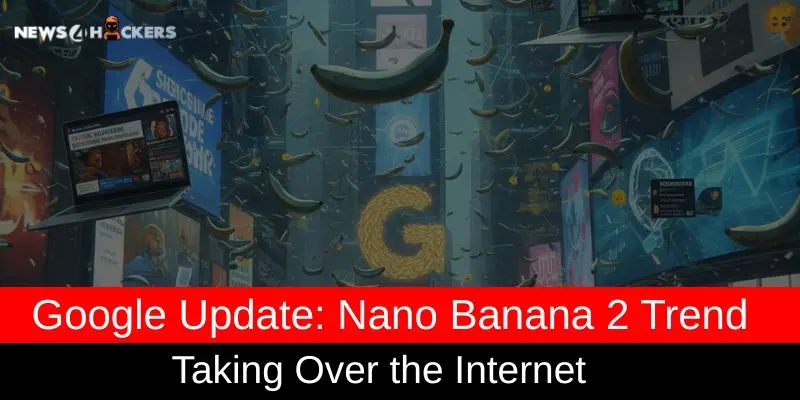
“Concerns about privacy and deepfakes are raised by Google DeepMind’s Nano Banana 2, a 4K AI picture generator with real-time data integration.”
Prepare for an eagerly anticipated update from the AI fruit bowl. Google DeepMind’s newest image-generation device, Nano Banana 2, also known as Nano Banana Pro, is causing a stir online.
Google has now released a more refined and potent version based on the Gemini 3 Pro architecture, following the viral popularity of the original Nano Banana model. Nano Banana 2 appears to be vying for the top spot in every creator’s toolkit with its studio-caliber graphics, multilingual text rendering, and search-based world knowledge.
We describe it in detail below, along with how it varies from its predecessor and some of the dangers and privacy issues you should be aware of.

Nano Banana 2: What is it?
Nano Banana 2 (Pro) is essentially the next-generation model for creating and modifying images. High-fidelity outputs (2K and 4K resolution), sophisticated editing tools (lighting, focus, color grading), and above importantly, clear, readable text included in the image are all supported.
In practical terms, this implies that a user can ask the model to create an infographic about cardamom tea that includes multilingual text, step-by-step illustrations, and actual data.
For world-knowledge grounding, the model uses Google Search, which enables it to incorporate real-time facts (such as sports or weather) when creating visualizations.
The Gemini app, Google Ads, Google Workspace, and the corporate API are just a few of the platforms where Nano Banana 2 is being released.
| Additionally, the version has integrated SynthID watermarks that identify the image as artificial intelligence-generated. |
The distinction between Nano Banana 1 and Nano Banana 2
Nano Banana 2 (Pro) is a more sophisticated advancement than Nano Banana 1 (officially Nano Banana), which dazzled viewers with its quick image editing and meme-worthy figurines. Support for 4K resolution and studio-level control over lighting, depth, and composition are among the major improvements.
Nano Banana 2 manages typography and multilingual text with expertise, in contrast to the previous edition, where text in photos frequently appeared strange or jumbled. In order to produce photos with real-world context (such as current data), the improved model incorporates Google Search, which the initial version did not have.
The “Pro” version better suits branding and professional workflows with multi-image inputs and reference style control (up to 14 pictures). To put it briefly, Nano Banana 1 was enjoyable and expressive. The Nano Banana 2 (Pro) is suited for the workplace and is expressive.

Dangers and Privacy Issues
It’s not all sunshine and bananas, though. The emergence of this imaging tool raises a number of warning signs that could be exploited for cybercrime. The possibility of producing realistic-looking but phony visuals rises with high-fidelity visual generation. More false information, impersonation, and brand abuse will result from this.
How is your data used when you upload prompts or images? Unless you opt out, Google’s systems may use your input for training, which raises concerns about privacy and consent.
Users and businesses must make clear who owns the output and how it can be used for commercial purposes, even if photographs have SynthID watermarks. Despite retrieving real-world data, the model may still have biases from its training set and make mistakes (label misalignment, contextual mishaps).
About The Author
Suraj Koli is a content specialist in technical writing about cybersecurity & information security. He has written many amazing articles related to cybersecurity concepts, with the latest trends in cyber awareness and ethical hacking. Find out more about “Him.”
Read More:
Delhi Police Launch ‘Operation Cyber Hawk’ Arrested 700 Cybercriminals for ₹1,000 Crore Fraud
About Author








 English