

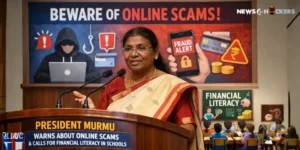
President Murmu Warns about Online Scams and Calls for Financial Literacy in Schools

President Murmu Warns about Online Scams and Calls for Financial Literacy in Schools
Bhubaneswar, Odisha: In order to protect Indians from online scams, President Droupadi Murmu expressed grave worry on Friday about the dramatic increase in cyber fraud cases nationwide. He called for a national effort to raise digital awareness and for financial literacy to be formally taught in schools.
“The rapid adoption of digital tools has brought immense convenience, but it has also exposed millions—especially in rural and tribal regions—to financial risks they are often ill-equipped to handle,” the president said at the Black Swan Summit, which was organized by the Odisha government in collaboration with the Global Finance and Technology Network (GFTN).
| Murmu emphasized that many residents in rural areas are still used to digital platforms and safety procedures, saying that “online financial frauds can wipe out a person’s lifelong savings and lead to severe mental and social distress.” |
She emphasized the necessity for extensive awareness programs to assist consumers in recognizing suspicious activity and prevent becoming victims of fraudsters, pointing out the susceptibility of novice users of online banking and payment systems.
| “People must be made more watchful and aware. “The first line of defense against cybercrime is awareness,” the president stated. |
Murmu also promoted the inclusion of financial literacy in school curricula, contending that educating children at a young age about digital payments, internet safety, and fundamental money management would better prepare them to live in an increasingly cashless society.
According to officials attending the summit, phishing attempts, bogus customer service calls, impersonation scams, and phony investment schemes have all contributed to a steady rise in recorded cyber fraud instances in India in recent years. Cybercrime is becoming easier to commit and more difficult to identify due to the quick growth of digital payments, especially among older users and those who are unfamiliar with internet services.
Murmu mentioned a number of programs the Center has started to improve cybercrime response and prevention systems in order to address these issues. These include the Citizen Financial Cyber Fraud Reporting and Management System, which helps authorities freeze stolen cash in real time and allows victims to report fraud promptly, and the Indian Cyber Crime Coordination Centre (I4C), which aims to enhance coordination among law enforcement agencies.

She also mentioned the Cyber Fraud Mitigation Center, which collaborates with digital platforms, telecom companies, and banks to detect new risks and stop fraud networks.
| “Although these structures are constantly being reinforced, institutional actions by themselves are insufficient. “Public awareness and participation are equally important,” stated Murmu. |
The President emphasized that digital safety and digital inclusion must coexist, especially as more and more government services, welfare payments, and daily transactions are conducted online. She called on state governments, academic institutions, and civil society organizations to work together on outreach initiatives that teach fundamental cyber hygiene, like safeguarding private data, staying away from dubious connections, and confirming financial requests.
Policymakers, computer specialists, and executives of the financial industry convened at the Black Swan Summit to talk about new threats in the digital economy and ways to create robust financial systems. According to Odisha officials, the state has been working harder to raise awareness of cyber issues, particularly in underdeveloped areas, by holding community seminars and helplines.
The event’s experts said that scammers are becoming increasingly skilled and frequently use counterfeit phone numbers, phony websites, and artificial intelligence to trick victims. They emphasized that the likelihood of recovery can be greatly increased by promptly reporting suspicious transactions.
In her closing remarks, Murmu urged citizens to use digital technologies responsibly and advocated for a team effort to fight cybercrime.
| “People should be empowered by technology, not have their means of subsistence jeopardized. We can guarantee that India’s digital journey stays inclusive and safe by awareness, education, and concerted action,” she stated. |
About The Author:
Yogesh Naager is a content marketer who specializes in the cybersecurity and B2B space. Besides writing for the News4Hackers blogs, he also writes for brands including Craw Security, Bytecode Security, and NASSCOM.
Read More:
Russian Hackers Accused By Italy of Cyberattacks Ahead of Winter Olympics
About Author







 English