

Spyware Threats Leading to New Smartphone Security Guidelines Issued by CISA
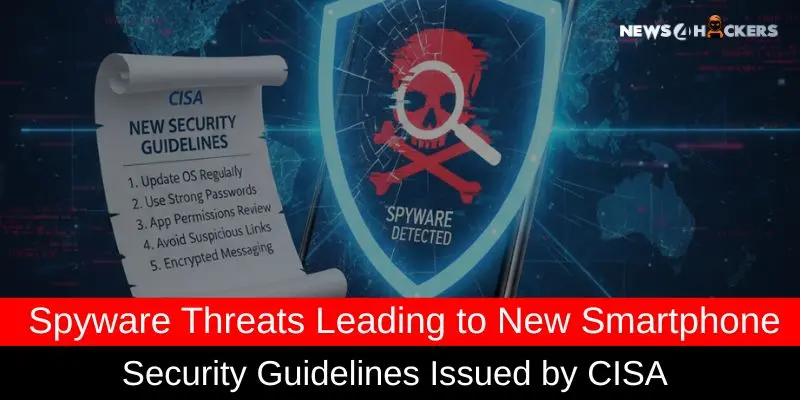
Spyware Threats Leading to New Smartphone Security Guidelines Issued by CISA
The U.S. Cybersecurity and Infrastructure Security Agency’s recently revised set of smartphone security standards is gaining attention as commercial spyware attacks, which target both regular users and those in critical professions, increase dramatically.
The guidelines, which are categorized as “traffic light protocol: clear,” provide unique, in-depth information about how federal cyber officials think people should protect their mobile devices from increasingly complex threats.
A Growing Threat to Ordinary Users
Federal cyber officials have noticed a concerning change in recent months: once-specialized monitoring tools that were often used by state actors or expensive intelligence contractors are now more freely available. A CISA report claims that “multiple cyber threat actors” are actively using commercial spyware to compromise end-to-end encrypted mobile messaging platforms.
Reports of Sturnus spyware being used to intercept private messages exchanged over Signal, Telegram, and WhatsApp have coincided with the emergence of this new environment. Similar attacks have been reported in UK local governments and among consumers of major financial and internet companies, including PayPal, Amazon, and Netflix. Spyware is becoming more adept at getting around the safeguards that users have long believed to be unbreakable.
CISA cautions that regular smartphone users may become collateral victims in larger attacks targeting higher-value persons, even while high-risk individuals such as journalists, activists, government employees, and military personnel continue to be the major targets.

Inside CISA’s Updated Mobile Security Guidance
For both iPhone and Android users, CISA’s “Mobile Communications Best Practice Guidance,” which has been revised and made publicly available, provides detailed instructions. The goal of the guidelines is to lower the “attack surface,” or the total number of digital channels that malevolent actors could use.
Lockdown Mode, a feature intended to restrict app and web activity in ways that thwart sophisticated surveillance technologies, is emphasized by CISA for iPhone users. The organization also suggests utilizing iCloud Private Relay to mask DNS searches, limiting app permissions with special attention to location, camera, and microphone access, and turning off fallback SMS options to guarantee messages stay properly encrypted.
Parallel measures are given to Android users, with extra focus on differences between manufacturers and the Android environment. CISA advises selecting devices from businesses that have a strong commitment to security updates, turning on only RCS messaging systems with end-to-end encryption, configuring high-privacy DNS resolvers like Google’s 8.8.8.8 or Cloudflare’s 1.1.1.1, and turning on Chrome safeguards like “always use secure connections” and “enhanced protection for safe browsing.” Tight permission limits and Google Play Protect complete the recommendations.
The Expanding Marketplace for Commercial Spyware
According to security experts, the timing of CISA’s revised guidelines is crucial. Once controlled by a few companies, the market for commercial spyware has grown quickly due to lower entry hurdles and fewer regulations. As a result, nation-states are no longer the only ones with access to tools that can monitor calls, messages, and network traffic.
These tools are increasingly taking advantage of flaws in mobile operating systems as well as messaging apps. Even cautious users may be vulnerable because many attacks rely on social engineering or little user interaction.
Attackers may indirectly target users as part of larger surveillance activities, according to CISA’s advisory. The CIA advises all users to implement basic defenses because a person’s conversations with journalists, diplomats, or political figures could be compromised only by association.

A Federal Push Toward Personal Cyber Hygiene
A federal cybersecurity agency’s distribution of detailed instructions for protecting smartphones is unprecedented. In the past, corporate administrators and operators of critical infrastructure have been the main recipients of such advice. The new paper, on the other hand, demonstrates a growing federal realization that personal gadgets used for communication, work, and increasingly identity verification have become crucial targets in contemporary cyber attacks.
No combination of settings can make a device impenetrable, hence CISA’s recommendations fall short of providing guarantees. However, the agency’s recommendations indicate a change in the federal government’s stance, recognizing that spyware is no longer a specialized threat and that specific actions, such as checking app permissions or turning on encrypted DNS, are now considered front-line defenses in the larger cybersecurity landscape.
About The Author:
Yogesh Naager is a content marketer who specializes in the cybersecurity and B2B space. Besides writing for the News4Hackers blogs, he also writes for brands including Craw Security, Bytecode Security, and NASSCOM.
Read More:
Researchers warn that New Android Malware can Empty Bank Accounts in just a Few Seconds
About Author






 English