

UIDAI Major Step: 25 M Dead Users’ Aadhaar Numbers Deactivated To Stop Fraud
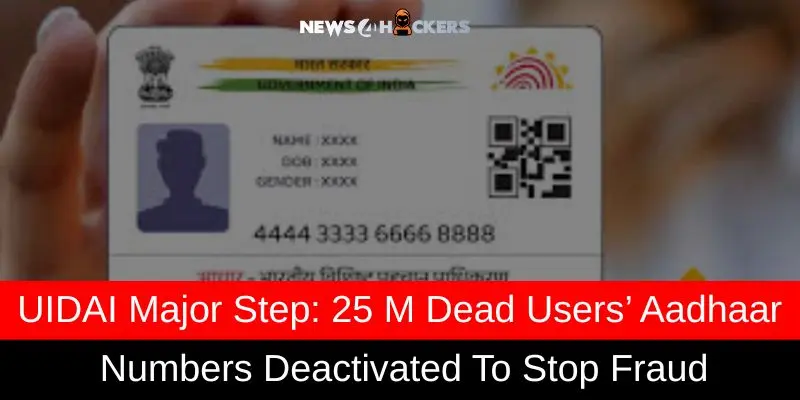
UIDAI Major Step: 25 M Dead Users’ Aadhaar Numbers Deactivated To Stop Fraud
“Congrats, UIDAI has taken a major step and deactivated a huge number of Aadhaar Numbers.”
More than 25 million Aadhaar IDs belonging to deceased people have been deactivated by the Unique Identification Authority of India (UIDAI), a major step towards improving the accuracy and dependability of the Aadhaar database.
The activity is a component of a national campaign to stop identity-related fraud and guarantee that only qualified recipients get government welfare benefits.
UIDAI
The potential of abuse is increased when an Aadhaar number is kept active after a person passes away, especially when it comes to subsidies, pensions, and other social assistance programs.
Because of this, post-death Aadhaar deactivation has been determined to be an important and required action. There are currently about 1.34 billion active Aadhaar users in India.
Why is it important to deactivate Aadhaar after death?
According to the Ministry of Electronics and Information Technology, deactivating Aadhaar after death helps reduce identity theft and improper use of public funds. The authority has also noted that cross-verification of data from several sources is crucial because the address listed in Aadhaar does not always match the state or Union Territory where the death is formally registered.
Security Precautions to Stop Fraud
UIDAI has put in place several precautions to improve Aadhaar security and lower the possibility of misuse, including:
- Biometric Lock/ Unlock: To stop unwanted attempts at authentication.
- Aadhaar Lock/ Unlock Facility: Enabling consumers to manage how their Aadhaar number is used.
- Face Authentication with Liveness Detection: To avoid impersonation and spoofing.
- Offline Verification Tools: Paperless offline e-KYC, secure QR codes, and associated features.
- No Sharing of Core Biometrics: Ensuring the privacy of biometric information.
- Encrypted Storage: Aadhaar data vaults must be used for safe storage.
- Regular Database Clean-up: Removing duplicates and deactivating deceased people’s Aadhaar numbers.
- Controlled Update Process: Only UIDAI-approved documentation may be used to update demographics.
Data Matching and the Future
UIDAI has used information from the Registrar General of India (RGI), state and Union Territory agencies, the Public Distribution System (PDS), and the National Social Assistance Programme to identify Aadhaar numbers associated with deceased people.
In order to obtain verified death records, the authority is also collaborating with banks and other organizations. Aadhaar numbers are never reissued, according to UIDAI. Deactivation following death is necessary to stop fraud and unlawful welfare benefit utilization.
The action is viewed as a critical step in enhancing the integrity, transparency, and legitimacy of the Aadhaar ecosystem.
About The Author
Suraj Koli is a content specialist in technical writing about cybersecurity & information security. He has written many amazing articles related to cybersecurity concepts, with the latest trends in cyber awareness and ethical hacking. Find out more about “Him.”
Read More:
The Ghaziabad Tragedy: When Online Addiction Becomes a Life-or-Death Task
About Author








 English