

WhatsApp Fake Wedding Card Link Hacked Phones in Rajasthan?
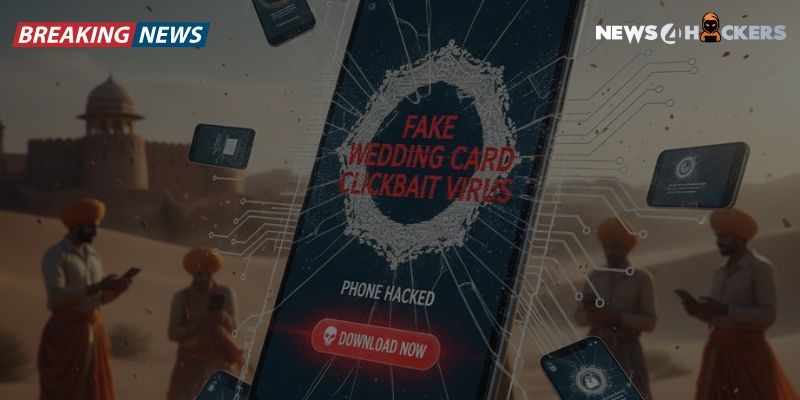
“Recently, fake wedding card links are circulating on WhatsApp, which is resulting in getting phones being hacked in Rajasthan.”
Before the holiday season, a woman’s WhatsApp group received a wedding invitation, which felt cozy and familiar, like a friend’s celebration. Over 150 women downloaded what looked to be a digital wedding card after clicking the link.
Many discovered their phones rendered worthless, bank accounts frozen, and WhatsApp removed within hours. It was not at all a wedding card. It was a malicious Android package called a fake APK file, which is intended to penetrate phones, take over apps, and possibly embezzle money.
It signaled the start of a new wave of socially engineered cyber scams, which coincided with India’s wedding and holiday season, when trust and digital sharing are at their peak, as cyber experts later warned.
The material was obtained by the victims, who were primarily elderly and homemakers, via the phones of acquaintances, many of whom had already been penetrated. Once installed, the malware acquired remote access to chat and payment apps like PhonePe and WhatsApp and blocked important features.

Lalita Khamesra
| “For Bhilwara housewife Lalita Khamesra, the trick started out innocently. She got a link from her friend’s number before Diwali. She remarked, “It looked real.” “I clicked it, but it didn’t open, so I went to bed.”
“Friends started phoning her in the interim. The same link had been forwarded from her phone to them. Lalita had unintentionally turned into a conduit for the hackers. She stated, “I hadn’t sent anything.” “I instructed everyone to reset their phones and remove the link.“ |
How Was Trust Used to Spread the Scam?
Her WhatsApp app had disappeared from her phone by morning. Despite State Bank of India’s security measures preventing money transfers, she discovered that her PIN had been altered when she checked her PhonePe account.
She hurried to the bank and took out her savings of ₹1.5 lakh. Panic erupted within the Mahila Mandal WhatsApp group. Some women barely avoided clicking since they were warned in time by other people’s messages. In order to recover control, those who had installed the APK quickly formatted their phones.
The Trap’s Technology
This most recent fraud, according to investigators and cybersecurity experts, is based on a straightforward but effective social engineering technique that manipulates confidence. Under the pretense of a wedding invitation, cybercriminals distribute an APK (Android Package Kit).
After downloading, it asks for rights that give the attacker complete access to the phone, including banking apps, contacts, messages, and files.
Ankush Saraswat, Cybersecurity Expert
| “According to Ankush Saraswat, a cyber specialist who has been monitoring similar occurrences in Rajasthan, “people drop their guard when they see a familiar name or a festive occasion.” In 90% of these situations, user error is the cause of the breach. Unknowingly, we give hackers control.” |
Frequently, the malicious files show up as harmless links from relatives or friends. Once enabled, they can modify security settings, remotely remove programs, and even propagate the same link via the victim’s WhatsApp.

In one instance, an elderly man stated that his phone was totally locked after following the link; only the call feature was functional for more than an hour before his son was able to get rid of the malware.
The timing of the attack is deliberate. Digital invitations are flooding email and WhatsApp inboxes as “Savos,” or auspicious wedding days, start in early November. Criminals are taking advantage of this cultural rhythm by skillfully integrating fraud into the online conversation of the season.
Takeaways from a Digital Age of Deceit
The public is being urged by authorities to be suspicious of unsolicited wedding or festival connections, even if they originate from known numbers. It is recommended that victims report cases through cybercrime.gov.in, call the cyber hotline 1930, and unlink their phones from banking apps as well.
Experts advise consumers to inspect their phone’s settings for suspicious files ending in “.apk,” “.exe,” “.pif,” “.vbs,” or similar extensions. These might point to hidden programs that have system-level access.
Reena Jain
| “The episode was a sobering reminder that digital trust is brittle for many of the women in Bhilwara. Another group member, Reena Jain, remarked, “We never thought a wedding card could be a trap.” Every day, we spread happiness on the internet. We are now afraid to even read a message.” |
India’s cybercrime units are preparing for more such instances as the wedding season draws near. Even the happiest invitation could conceal a subtle danger, so what started out as a season of celebration has evolved into a lesson in digital vigilance.
About The Author
Suraj Koli is a content specialist in technical writing about cybersecurity & information security. He has written many amazing articles related to cybersecurity concepts, with the latest trends in cyber awareness and ethical hacking. Find out more about “Him.”
Read More:
Sole Trader Sent Approx 1M Spam Texts to UK Residents in Debt, Reports ICO
About Author






 English