

WhatsApp Unleashes High-Security Mode: Meta Ensures the Safety of Users
“To secure the users from spyware, WhatsApp has introduced a new amazing feature.”
In order to protect specific users from sophisticated cyberattacks based on their identity and activities, Meta announced on Tuesday that it is implementing Strict Account Settings on WhatsApp.
By sacrificing some functionality for increased protection, the feature, which is comparable to Lockdown Mode in Apple iOS and Advanced Protection in Android, aims to shield people, like journalists or public figures, from sophisticated spyware.

When this security mode is activated, attachments and media from users who are not in their contacts will be blocked, and several account settings will be locked to the most restrictive settings.
Meta
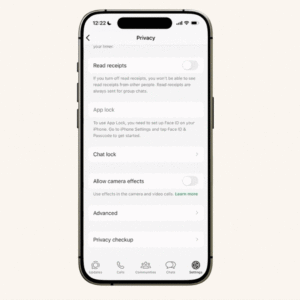
| “With just a few taps, this lockdown-style feature strengthens your WhatsApp security even further by locking your account to the most restrictive settings, such as automatically blocking media and attachments from senders you don’t know, blocking calls from strangers, and limiting other settings that might limit the app’s functionality.”
Go to Settings > Privacy > Advanced to activate the option. Over the next few weeks, the functionality will be released progressively. |
In order to protect users’ images, videos, and messages from spyware assaults, the social media behemoth said that it is implementing the Rust programming language in its media sharing feature. The creation was referred to as the “largest rollout globally of any library written in Rust.”
Meta
| In addition to its investment in a three-pronged strategy to address memory safety issues, the adoption of Rust allowed for the development of a secure, high-performance, cross-platform library (“wamedia”) for media sharing in WhatsApp across devices:
● Reduce needless attack surface exposure when designing the product. ● For the remaining C and C++ code, spend money on security assurance. ● Memory-safe languages are by default selected for new code.
“CFI, hardened memory allocators, safer buffer handling APIs, and other safeguards have been implemented in WhatsApp.”
“As part of our continuous defense-in-depth strategy, this is a significant advancement in adding more protection for users behind the scenes.” |
About The Author
Suraj Koli is a content specialist in technical writing about cybersecurity & information security. He has written many amazing articles related to cybersecurity concepts, with the latest trends in cyber awareness and ethical hacking. Find out more about “Him.”
Read More:
A Tax Phishing Campaign Targets Indian Users, Blackmoon Malware Delivery
About Author









 English