

Indian SMEs Face Cybersecurity Challenges Amid Rising Security Concerns
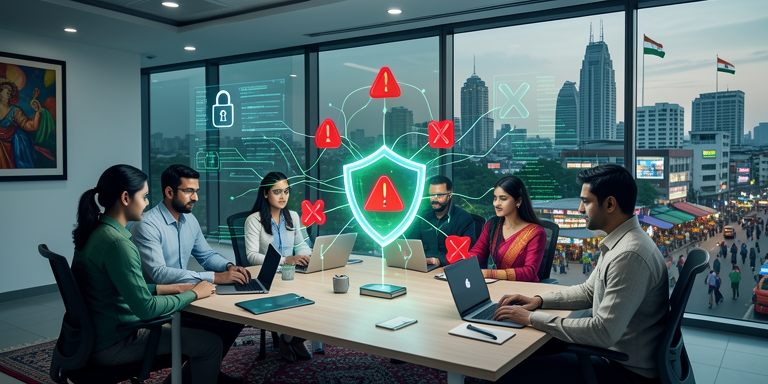
Indian small and medium enterprises are enhancing their emphasis on cybersecurity measures, yet a significant portion continues to depend on sporadic or manual security protocols, creating a mismatch between evolving threats and their capacity to identify and mitigate breaches.
Assessment of Cybersecurity Investment Plans
Data reveals that 84% of Indian SMEs intend to raise cybersecurity expenditures within the next 12 to 24 months. However, 61% maintain inconsistent security oversight, underscoring a disparity between financial commitments and practical execution.
The Cybersecurity Landscape
The cybersecurity landscape for these businesses encompasses persistent ransomware attacks, malware proliferation, phishing schemes, supply-chain vulnerabilities, and emerging risks across sectors such as IT services, e-commerce, manufacturing, BFSI, healthcare technology, EdTech, and travel technology.
Evaluation of Threat Monitoring Practices
Only 35% of SMEs conduct cybersecurity assessments on a quarterly or biannual basis, while 20% employ ad-hoc methods. Just 17% have adopted 24×7 continuous monitoring systems, and 18% implement regular reviews supported by structured reporting frameworks. This approach leaves critical gaps, as cyber incidents often unfold rapidly beyond the scope of traditional evaluation cycles.
Delays in Detecting Anomalous Activity
Delays in detecting anomalous activity provide attackers extended opportunities to infiltrate and compromise systems. Findings indicate that 45% of SMEs require four hours or more to detect and contain incidents. For businesses operating without interruption, this lag allows adversaries to expand their presence within networks or inflict further damage.
Analysis of Incident Detection Timelines
The consequences of delayed detection are evident in SMEs that have experienced breaches. Among affected organizations, 19% reported operational disruptions or downtime, 17% faced data leakage or loss, and 15% encountered unauthorized system access.
Impact of Artificial Intelligence on Cybersecurity
Artificial intelligence is reshaping the threat environment, with 65% of SMEs perceiving AI-driven attacks as formidable challenges they struggle to visualize or counter. Additionally, 34% anticipate AI-powered cyber threats will significantly impact their operations within the next two years.
Barriers to Effective Cybersecurity Implementation
Financial constraints remain a primary obstacle, with 65% of respondents citing cost as the main hindrance to implementing robust security measures. Integration complexity (43%) and budget limitations (23%) further impede progress. Nearly 65% acknowledge inadequate in-house network security capabilities, while 33% lack incident-response mechanisms.
Utilization of External Security Services
Many SMEs are outsourcing security monitoring to third-party providers. Approximately 40% rely on periodic or manual checks for risk assessments, compared to 28% using continuous monitoring and automated alerts. Despite this, 73% express dissatisfaction with their current cybersecurity infrastructure.
Recommendations for Proactive Security Measures
Recommendations emphasize transitioning to real-time security monitoring, leveraging specialized cybersecurity expertise, and adopting outcome-based metrics such as mean time to detect and mean time to contain incidents. Managed security partnerships are highlighted as a strategy to bridge internal capability gaps while maintaining round-the-clock security operations.
Critical Need for Proactive Security Measures
Increased cybersecurity spending alone will not suffice if threats remain undetected for hours after infiltration. For SMEs, the urgent priority lies in converting security budgets into continuous monitoring, accelerated detection, skilled response teams, and enhanced internal capabilities. The statistic that 45% require four hours or more to address incidents underscores the growing necessity for always-on visibility to mitigate risks effectively.
“Artificial intelligence is reshaping the threat environment, with 65% of SMEs perceiving AI-driven attacks as formidable challenges they struggle to visualize or counter.”

About Author





 English