

Compare EDR XDR MDR: Evaluate Response Outcomes
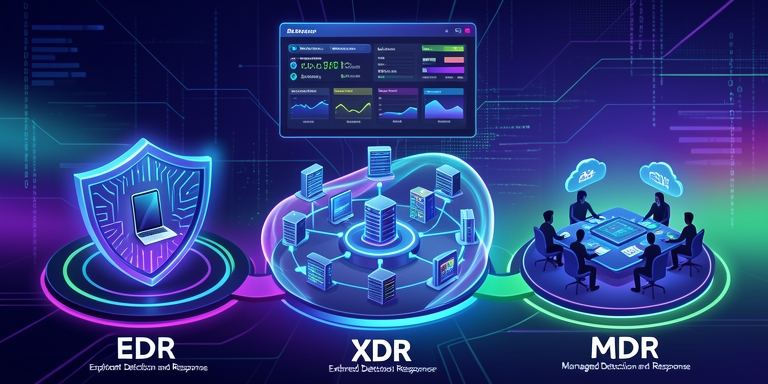
How to Evaluate EDR, XDR, and MDR Based on Response Outcomes August 27, 2026
The effectiveness of endpoint security platforms is best demonstrated during real-world incidents rather than during vendor demonstrations.
The critical evaluation question is whether the platform provides the investigation team with actionable data when an alert escalates to a confirmed breach. Platforms that fail to address this gap contribute to alert fatigue without improving incident resolution. Detection accuracy alone is not a sufficient metric. A platform may exhibit strong detection rates yet lack the ability to support scope assessment, timeline reconstruction, or containment decisions during an active incident.
CISA guidelines emphasize behavioral detection and incident response capabilities as essential components of robust endpoint security programs, reinforcing the need to prioritize response outcomes over detection volume.
The evaluation process should determine if an analyst can answer three core investigation questions using only the platform’s data. This approach highlights platforms that generate alerts without enabling investigation workflows, a gap that prolongs response times under pressure.
Telemetry depth and retention are critical factors in assessing platform capabilities.
Key considerations include whether full-fidelity data requires premium features or additional configuration, the default and maximum retention periods, and the ability to query process execution history across extended timeframes. Platforms with limited retention or minimal telemetry fail to support incident reconstruction when threats are detected after the initial evidence window.
Testing telemetry completeness involves verifying access to full process trees, network connection logs, and file operation records.
Retention analysis reveals tradeoffs between cost and investigative readiness, with default periods below 30 days indicating prioritization of budget over operational needs.
Detection quality hinges on behavioral analysis of post-compromise activities, such as the use of legitimate system tools in suspicious patterns.
Testing scenarios involving PowerShell execution, WMI lateral movement, and scheduled task persistence should demonstrate technique-level detection rather than reliance on malware signatures. Signature-based systems create blind spots during investigations, as attackers often exploit living-off-the-land techniques.
Evaluation criteria must assess detection granularity, such as distinguishing between authorized administrative PowerShell use and malicious encoded command execution.
Investigation support depends on pivot capabilities, timeline reconstruction, and cross-host correlation. Analysts should be able to identify all hosts communicating with a compromised system, reconstruct attacker activity across multiple devices, and search for indicators of compromise across the entire environment.
Platforms that lack these features force manual correlation, creating bottlenecks during complex incidents.
Response and containment capabilities include network isolation, remote process termination, and integration with identity systems for credential revocation. Platforms requiring external tools for these actions delay containment, increasing attacker dwell time.
Integration testing should confirm network isolation that maintains telemetry, remote process termination with execution confirmation, and automated credential response through identity systems.
The platform’s ability to deliver investigation context to SIEM or SOAR systems determines its role in coordinated incident response.
MDR evaluation requires distinguishing between services that provide investigative insights and those that only deliver alerts.
Key questions include the SLA for scope assessment, the format of deliverables, and the extent of support during active incidents. Services that fail to demonstrate these capabilities offer alert triage rather than investigative assistance.
Proof of concept testing should simulate real attack sequences, including initial execution, lateral movement, persistence, and data staging.
The platform must enable analysts to reconstruct the full attack timeline, identify affected hosts, and search for persistence mechanisms without external tools. This test reveals whether the platform supports end-to-end investigation or requires supplementary forensic solutions.
Evaluation questions should focus on workflow demonstration rather than feature descriptions.
For example, analysts must show how to identify all hosts communicating with a compromised system using only the platform’s data. Inadequate responses include reliance on external network monitoring tools or inability to correlate cross-system activity.
Behavioral detection quality is assessed by evaluating technique-level identification of living-off-the-land patterns.
Platforms that depend on signature-based detection cannot recognize suspicious use of legitimate tools.
Response action integration is verified through remote isolation, process termination, and credential revocation capabilities.
The platform must provide actionable context to SIEM/SOAR systems without requiring direct access to endpoint tools.

About Author








 English