

Indian Embassy Warns of Fraud Calls Threatening ‘Digital Arrest’ in US
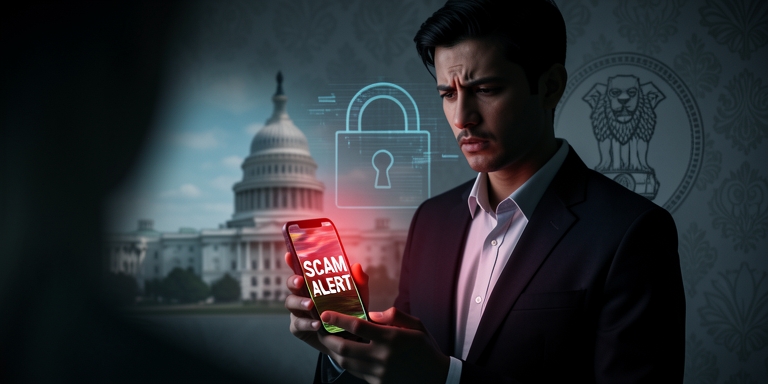
Indian Embassy Alerts Diaspora to Rising Scam Involving Fake “Digital Arrest” Threats
Fraudulent actors are targeting members of the Indian diaspora in the United States by impersonating embassy and consulate officials, leveraging deceptive tactics to extort funds.
Reports indicate a dramatic increase in such incidents, with complaints rising from eight in 2024 to 613 in 2025. These schemes involve false claims of criminal or terrorist links tied to victims’ Indian mobile numbers, accompanied by demands for payments to resolve fabricated legal issues. Criminals employ spoofed U.S. phone numbers to create the illusion of legitimacy, then allege that victims’ mobile numbers are associated with financial crimes, terrorism, or other offenses. They pressure individuals to pay for services such as investigation fees, clearance certificates, or document processing. This modus operandi mirrors the “digital arrest” scam prevalent in India, which has resulted in significant financial losses.
Several Indian-American residents have shared accounts of these interactions, with scammers falsely representing entities like the Indian Consulate in San Francisco, the Ministry of External Affairs, or Delhi Police.
Many victims reported that attackers possessed accurate personal information, including names and phone numbers, enhancing the credibility of the deception. A parallel surge in cyber threats targeting Indian families in the U.S. has been linked to heightened immigration-related anxieties. Data from the Ministry of External Affairs, presented in the Rajya Sabha, reveals a sharp rise in blackmail cases during the same period. Immigration professionals attribute this trend to stricter U.S. immigration policies implemented in 2025.
In these instances, fraudsters pose as officials from U.S. Citizenship and Immigration Services, Homeland Security, or Immigration and Customs Enforcement, alleging discrepancies in immigration records and threatening deportation.
Some perpetrators shifted to impersonating Indian Embassy staff after the immigration-related scams lost effectiveness, indicating coordinated efforts by criminal networks. The Embassy of India in Washington has issued a public advisory confirming that scammers are exploiting consular phone lines to extort victims, often citing errors in consular documents or fabricated complaints. Authorities are collaborating with U.S. agencies to investigate the pattern and urge the diaspora to report suspicious calls to local law enforcement and diplomatic missions.
Experts highlight the growing sophistication of these scams, driven by advancements in artificial intelligence, caller ID spoofing, and voice cloning technologies.
Prof. Triveni Singh, a former IPS officer and cybercrime specialist, noted that impersonation of government and law enforcement entities has become a highly effective social engineering tactic. He emphasized that the public should avoid panicking or making payments in response to unsolicited calls and instead verify the caller’s legitimacy through official channels. India has also observed a surge in similar impersonation cases in other countries, including Cambodia and Myanmar, suggesting a broader global trend. Cybercriminals are exploiting the vulnerabilities of Indian communities navigating complex bureaucratic systems in both India and the U.S.
According to the Embassy of India in Washington, scammers are exploiting consular phone lines to extort victims, often citing errors in consular documents or fabricated complaints.
Conclusion
The Indian Embassy has issued a public advisory to the diaspora, urging vigilance against these scams. Authorities are working with U.S. agencies to investigate and combat this growing threat. The public is advised to verify the legitimacy of unsolicited calls and report suspicious activities to local law enforcement and diplomatic missions.
FAQs
How can I verify if a call from the Indian Embassy is genuine?
Contact the official Indian Embassy or Consulate directly using verified contact information. Do not rely on numbers provided by the caller.
What should I do if I receive a suspicious call?
Report the call to local law enforcement and the Indian Embassy. Avoid making any payments or sharing personal information.
Are these scams limited to the U.S.?
No. Similar impersonation cases have been reported in other countries, including Cambodia and Myanmar, indicating a global trend.

About Author








 English