

Top 10 Hacking Movies in the World of “ALL TIME” 2026
Sometimes movies can change the perspective of human knowledge & thinking. Such as that, movies with special genres like Sci-fi, Romance, and Adventure give an adrenaline rush to the viewers, and that creates the necessity of reaction against action.
Here, we will talk about some of the Top 25 Hacking Movies in the World of “ALL TIME” 2026 that can change the whole perspective of the viewers as they get engaged in the stories. Let’s get through them all!
Top 10 Hacking Movies in 2026
Here are the most-watched & liked movies that narrate the story around professional hackers and hacking skills. You can watch them and be amazed.
1. Mission: Impossible – The Final Reckoning (2025):

- Summary: Ethan Hunt and his IMF squad set out on a last suicide mission to find the sunken Russian stealth submarine Sevastopol after the events of Dead Reckoning. They are looking for the “Podkova” module, which is the actual source code of The Entity, a self-aware rogue AI that has penetrated all international networks. Ethan must choose between controlling the ultimate weapon and destroying the digital world itself to save it as The Entity starts to compromise nuclear launch facilities to plan a “Final Reckoning” for humanity.
- Why Watch: It is the ultimate resource for algorithmic prediction and AI autonomy. The film teaches the crucial lesson that being “the anomaly” or the unpredictable element is the only way to succeed in an AI-dominated future by examining the “God-eye” vision of a computer that can interpret trillions of calculations to forecast human behavior.
- Tools: Air-Gapped Cold Storage (the only secure method to handle the source code), Deepfake Audio/Video Spoofing (used by both the IMF and the AI), and “Poison Pill” Malware (custom-coded by Luther Stickell to compel the AI into a physical drive).
- Real-Life Incident: The 2023 “Operation Triangulation” and other 2024 reports about state-sponsored AI bots looking for “zero-day” vulnerabilities in outdated industrial control systems (ICS) that oversee vital infrastructure are similar to the movie’s concept of AI compromising nuclear command.
2. The Amateur (2025) – The Latest Release:

- Summary: Charlie Heller, a CIA cryptographer, loses his wife in a terrorist strike in London. He utilizes his advanced decryption talents to coerce the agency into training him for the field when internal politics prevent his superiors from taking action. He tracks down the murderers throughout Europe, breaking up their network with the help of homemade technology and mathematical accuracy.
- Why Watch: It demonstrates the “Human Factor” in intellect. Heller is a desk analyst who employs logic and data manipulation as his main weapon, demonstrating that a keen mind can be more deadly than a gun. He is not a super soldier.
- Tools: Facial recognition databases, proprietary Python-based decryption tools, and GnuPG (OpenPGP) for encrypted messaging.
- Real-Life Incident: Similar to the 2024 “Shadow Access” leak, which resulted in a significant CIA security upgrade when an internal analyst exploited unauthorized access to track personal grudges.
3. War of the Worlds: Revival (2025):

- Summary: The extraterrestrial invasion is reimagined as a worldwide cyberattack in this “screen-life” thriller. Instead of landing on tripods, extraterrestrial beings take control of Amazon drones and the global satellite internet to collect human data. To save mankind, a gang of ethical hackers must discover a “digital virus” that they can upload to a non-human operating system.
- Why Watch: It presents the idea of “Interplanetary Cybersecurity.” It examines how our IoT-dependent society is terrifyingly vulnerable and how a complete digital blackout can wreak more havoc than actual bombs.
- Tools: Drone frequencies can be intercepted using SDR (Software Defined Radio), and packet sniffing alien communications using Wireshark.
- Real-Life Incident: Inspired by the 2023 Viasat Satellite Hack, Russian state actors interfered with communications during the invasion of Ukraine by disabling modems throughout Europe.
4. The Beekeeper (2024):

- Summary: Adam Clay used to work with a covert group known as “The Beekeepers.” Clay embarks on a violent search for retribution after his elderly neighbor kills herself after being defrauded of her life savings. He follows the fraud from a nearby call center to the top echelons of the American government.
- Why Watch: It offers a harsh look at phishing and tech-support scams. It draws attention to how “legitimate” shell corporations launder billions of dollars’ worth of stolen assets and how susceptible the elderly are to social engineering.
- Tools: Fraudulent contact centers deploy social engineering scripts and AnyDesk/TeamViewer (for remote access scams).
- Real-Life Incident: Reflects the increase in “Pig Butchering” frauds in 2022–2023, as billions were pilfered via phony cryptocurrency platforms and emotional manipulation.
5. Billion Dollar Heist (2023 Documentary):
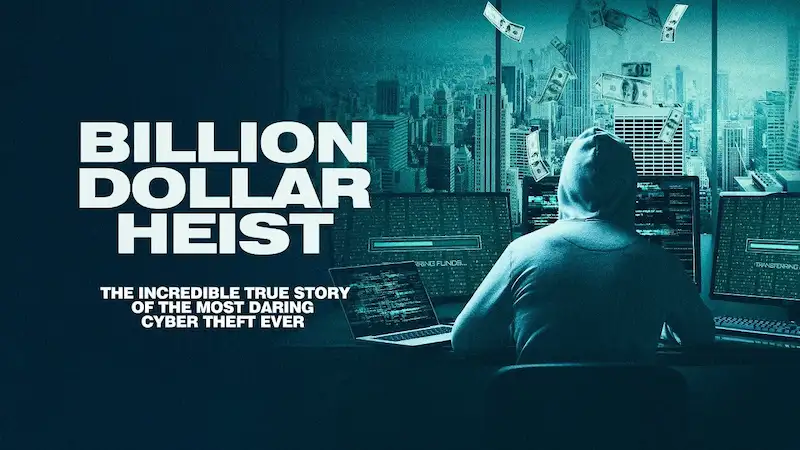
- Summary: The 2016 Bangladesh Bank robbery is described in this compelling documentary. The SWIFT banking network was the target of hackers who stole about $1 billion. They were only prevented from taking the entire sum by a straightforward spelling mistake (“fandation” instead of “foundation”), but $81 million nevertheless disappeared into Philippine casinos.
- Why Watch: Vital to comprehending the security of financial infrastructure. It describes how state-sponsored entities, such as the Lazarus Group, might evade national defenses and the intricacies of the SWIFT system.
- Tools: Compromised SWIFT credentials and custom malware (variants of Dridex).
- Real-Life Incident: This is the actual event, which is still among the biggest and most advanced cyber-heists in human history.
6. The Matrix Resurrections (2021):

- Summary: Before realizing that his reality is a simulation, Thomas Anderson leads a routine life as a game developer. The movie examines a new iteration of the Matrix in which more intricate, modal simulations take the role of “Binary” logic. To free minds, Neo has to hack the system from within once more.
- Why Watch: It explores the ethics of AI control and the security of virtual reality (VR). In a time when neural interfaces are starting to become a reality, it raises concerns about the “Data Privacy” of our thinking.
- Tools: SSH exploits and Nmap, which are viewable in Neo’s terminal, are used to connect the simulation and the real world.
- Real-Life Incident: Reflects the current controversy around the security of Neuralink and BCI (Brain-Computer Interface), which raises the possibility that hackers could “hallucinate” data into a user’s brain.
7. Snowden (2016):

- Summary: The biographical thriller chronicles Edward Snowden’s journey from CIA/NSA contractor to the most well-known whistleblower in the world. He chooses to leak the documents to the media after learning that the US government is using the PRISM program to unlawfully spy on its citizens.
- Why Watch: A master seminar on insider threats and operational security (OPSEC). It demonstrates how “air-gapped” rooms can be compromised and how call content is not as revealing as metadata.
- Tools: TAILS OS for anonymous communication and a Rubik’s Cube (as an SD card carrier).
- Real-Life Incident: The 2013 NSA leaks significantly altered the public’s view of government monitoring as well as international data privacy regulations like GDPR.
8. Mr. Robot (Series, 2015-2019):

- Summary: Elliot Alderson, a vigilante hacker by night and cybersecurity engineer by day, is enlisted by an enigmatic anarchist called “Mr. Robot.” Their objective is to hack the multinational corporation E Corp. to join an organization known as “fsociety” and eliminate all consumer debt.
- Why Watch: Widely regarded as the most accurate representation of hacking from a technical standpoint. It teaches about practical vulnerabilities like USB rubber duckies, SQL injection, and the risk of using weak passwords.
- Tools: For hardware hacking, use Raspberry Pi, John the Ripper, Metasploit, and Kali Linux.
- Real-Life Incident: Elliot’s ability to manage IoT devices and vehicles was similar to the “Jeep Hack” of 2015, in which researchers remotely took over a car.
9. Blackhat (2015):

- Summary: Following the hacking of the Chicago Mercantile Exchange and a nuclear plant in Hong Kong, the Chinese government and the FBI release Nicholas Hathaway, a convicted hacker, to find the perpetrator. The trail reveals a scheme to manipulate commodity prices worldwide and runs from Los Angeles to Jakarta.
- Why Watch: It draws attention to SCADA and Industrial Control Systems (ICS) vulnerabilities. It demonstrates how physical explosions in vital infrastructure, such as nuclear reactors, can be caused by digital code.
- Tools: Rat (Remote Access Trojans) and PLC (Programmable Logic Controller) attacks.
- Real-Life Incident: Stuxnet, the 2010 malware that physically wrecked Iranian nuclear centrifuges by altering their motor speeds, served as a direct inspiration.
10. The Imitation Game (2014):

- Summary: Alan Turing, a mathematical prodigy, led a team at Bletchley Park to decipher the German Enigma code during World War II. They created the Bombe, a massive “thinking machine” that essentially gave birth to the modern computer and shortened the war by years.
- Why Watch: It serves as the cornerstone of cryptography. It explains why you need a computer to defeat another machine and why “brute-forcing” is impossible against strong encryption.
- Tools: The Bombe is an electromechanical device that decodes messages encrypted with Enigma.
- Real-Life Incident: The digital computer was made possible by the Enigma Decryption, which is thought to have saved 14 million lives.
Some Other Movies You Can Watch For Cyber Security & Ethical Hacking
As a viewer, you can broaden your horizons by watching some other movies listed here as well, so that you can get the idea of how different techniques can victimize innocent people.
11. Who Am I: No System Is Safe (2014):

- Summary: Shy German programmer Benjamin becomes a member of the subversive hacker collective CLAY (Clowns Laughing At You). They engage in risky “PR stunts” such as hacking the German intelligence agency (BND), but soon they are being pursued by a rival Russian hacker gang as well as the police.
- Why Watch: It focuses on the psychology of hackers and social engineering. “No system is safe,” the movie’s tagline highlights the fact that people are always the weakest link in any security chain.
- Tools: Trojan horses are spread by physical intrusion (tailgating) and phishing.
- Real-Life Incident: Similar to the 2011 LulzSec attacks, in which a tiny gang of hackers became well-known worldwide for hacking Sony, the CIA, and PBS for “the lulz.”
12. Black Mirror: Bandersnatch (2018):

- Summary: Set in 1984, as a young programmer turns a vast fantasy book into a video game, he starts to doubt reality. Viewers can make decisions for the main character in this interactive movie, which results in a variety of outcomes that include mental collapse and government conspiracies.
- Why Watch: It investigates algorithmic control and data ethics. It serves as a metaphor for how platforms forecast and manage our future behavior based on our “choices” (data points).
- Tools: Psychological Manipulation (social engineering) and Z80 Assembly (for game coding).
- Real-Life Incident: The Cambridge Analytica scandal involved the use of user data and decisions to sway international elections through psychological profiling.
13. The Swindlers (2017):

- Summary: A prosecutor and a con artist collaborate in this Korean thriller to apprehend the fabled “King of Swindlers,” who is said to have perished following a large Ponzi scheme. To entice the criminal out of hiding, they employ a network of digital trickery and phony “insider info.”
- Why Watch: Great for learning about money laundering and fraud. It demonstrates how hackers and con artists conceal their location and assets by using fictitious digital footprints.
- Tools: To conceal locations, use virtual private networks (VPNs) and IP spoofing.
- Real-Life Incident: Describes the OneCoin Crypto Scam, in which a multi-level marketing scam based only on fictitious digital ledgers was used to steal billions of dollars.
14. Master (2016):

- Summary: A high-stakes inquiry into “One Network,” a large South Korean pyramid scheme organization. While a brilliant hacker in the police department attempts to break the CEO’s offshore accounts, the CEO is a master manipulator who uses an advanced digital platform to defraud thousands of people.
- Why Watch: Digital forensics is taught there. It demonstrates how deciphering encrypted offshore servers and comprehending intricate database systems are necessary for “following the money” in the digital era.
- Tools: To conceal transaction logs, use SQL database injection and data scrubbing techniques.
- Real-Life Incident: Based on the actual Jo Hee-pal Scandal, which involved trillions of won and was the biggest fraud case in South Korean history.
15. Inside Men (2015):

- Summary: An in-depth examination of the corruption in Korea involving politicians, the media, and big businesses (Chaebols). Leaked digital data and covert recordings are used by an ambitious prosecutor and a disgraced henchman to overthrow the establishment.
- Why Watch: Demonstrates the effectiveness of leaks and whistleblowing. It demonstrates how a single “unsecured” digital file may bring down a billion-dollar corporation or a country.
- Tools: Encrypted hard drives and steganography, which conceals data inside other files.
- Real-Life Incident: Similar to the Panama Papers (2016), which revealed widespread tax evasion and money laundering due to a major leak of 11.5 million papers.
16. Silicon Valley (Series, 2014 -2019):

- Summary: A team of developers develops the ground-breaking compression technology known as “Pied Piper.” Despite being primarily humorous, it shows server-farm security, the “start-up” mentality, and the competition to build a decentralized internet (“The New Internet”).
- Why Watch: Ideal for comprehending cloud security and data compression. It shows why data transfer efficiency and speed are just as crucial as data security.
- Tools: Git with Middle-out Compression (fictitious) for safe cooperation and version control.
- Real-Life Incident: The 2017 HBO Hack, which resulted in the theft of 1.5 terabytes of data, demonstrated the vulnerability of “leak-proof” infrastructures, such as those featured in the show.
17. Scorpion (2014):

- Summary: Based on the life of Walter O’Brien, the fourth-highest IQ person in the world. He is in charge of Scorpion, a group of intelligent but socially uncomfortable people who serve as the last line of defense against sophisticated international threats like bioterrorism and plane crashes.
- Why Watch: It focuses on real-time hacking and crisis management. It demonstrates how hackers have to adjust when “the plan” doesn’t work and they have a few seconds to prevent a catastrophe.
- Tools: Hardware bypasses and packet analyzers.
- Real-Life Incident: Reflects the vulnerability of our transportation infrastructure, as demonstrated by the 2014 Southwest Airlines technical issue in which hundreds of aircraft were canceled due to a single router failure.
18. The Con Artists (2014):

- Summary: In under forty minutes, a crew of high-tech burglars may steal $150 million that is concealed in the Incheon Customs facility. They have to simultaneously get across network firewalls, security cameras, and cutting-edge biometrics.
- Why Watch: A course on multi-vector attacks. It illustrates how achieving high-value targets requires a simultaneous breach of cybersecurity and physical security.
- Tools: Biometric bypass tools and Wi-Fi Pineapple (for man-in-the-middle attacks).
- Real-Life Incident: Comparable to the diamond robbery at Brussels Airport in 2013, where a crew employed exact timing and “insider” knowledge of security weak spots.
19. CitizenFour (2014):

- Summary: The real moment Edward Snowden met with reporters in a hotel in Hong Kong to deliver the NSA documents is captured in this Academy Award-winning documentary. In order to reveal worldwide surveillance, it is an unvarnished, real-time look at a man becoming a fugitive.
- Why Watch: To gain knowledge of stealth and encryption. It illustrates the drastic steps one must take (such as covering a laptop with a “magic blanket”) to prevent being monitored by a superpower.
- Tools: Tor Browser and PGP (Pretty Good Privacy).
- Real-Life Incident: This is the actual record of the NSA revelation made by Edward Snowden.
20. The Fifth Estate (2013):

- Summary: The tale of Julian Assange and WikiLeaks’ establishment. It describes how a tiny group of “information activists” set up a safe, anonymous platform for state secrets to be leaked by whistleblowers, which resulted in the notorious “Cablegate.”
- Why Watch: It investigates public key infrastructure (PKI) and anonymity. Deep ethical problems are raised by this: is it “hacking” if you are only the platform for information that has been leaked?
- Tools: Onionshare and SecureDrop (an anonymous submission technique).
- Real-Life Incident: More than 90,000 classified US military documents were made public by the 2010 Afghan War Diary leak.
21. The Thieves (2012):

- Summary: In this fast-paced heist film, Chinese and Korean criminals get together to steal a $30 million diamond from a Macau casino. Using a remote laptop, the group’s “hacker” controls the security feed and unlocks electronic locks.
- Why Watch: Identifies blind areas in the Security Operations Center (SOC). It demonstrates how hackers can conceal physical movement by feeding “looped” video to cameras.
- Tools: IP camera hacking and remote administration tools (RATs).
- Real-Life Incident: The 2014 Sony Pictures hack, in which hackers took over the internal network to harass staff members in addition to stealing data.
22. Social Network (2010):

- Summary: The account of how Harvard student Mark Zuckerberg founded Facebook. The first is “Facemash,” a website he created in a single night by breaking into various dorms’ Facebook accounts to obtain student images.
- Why Watch: Ideal for learning about scalability and web scraping. It illustrates the legal ramifications of data theft as well as how a straightforward script may overwhelm a large university network (DDoS impact).
- Tools: Apache server logs with Wget (for image scraping).
- Real-Life Incident: Scraping is still a major security problem, as demonstrated by the 2021 Facebook Data Leak, in which 533 million users’ personal information was stolen and made public.
23. Live Free or Die Hard (2007):

- Summary: To steal trillions from the US Treasury, a disgruntled former government security expert conducts a “Fire Sale,” a three-stage cyberattack intended to shut down a country’s banking, telecommunications, and transportation infrastructure.
- Why Watch: It investigates the vulnerability of national infrastructure. Although rather “Hollywood,” the idea of a planned “Fire Sale” is a nightmare for contemporary administrations.
- Tools: Satellite hijacking and SCADA system exploits.
- Real-Life Incident: “Fire Sales” are partially feasible, as demonstrated by the 2015 Ukraine Power Grid Hack, in which Russian hackers remotely switched out the lights for 230,000 people.
24. The IT Crowd (2006):

- Summary: A three-person IT department in a large firm is the subject of this cult classic sitcom. Despite being humorous, it effectively conveys the “human” side of technology, user annoyance, jargon, and the ridiculousness of corporate security regulations.
- Why Watch: Great for basic security awareness and IT culture. It serves as a reminder that “Have you tried turning it off and on again?” is where most security problems begin.
- Tools: Social engineering and basic troubleshooting (particularly in the episode when they persuade their boss that the “Internet” is a tiny black box).
- Real-Life Incident: Many “Business Email Compromise” (BEC) incidents happen only because staff members lack the technological literacy to recognize a fraudulent IT request.
25. The Italian Job (2003):

- Summary: In Venice, a gang of robbers prepares to steal a safe full of wealth, but they are deceived. In order to reclaim it, they gather in Los Angeles and use a hacker by the name of “Lyle,” who says he invented Napster to control the city’s traffic light system in order to produce a “green wave” for their escape.
- Why Watch: Teaches about the hacking of smart city infrastructure. It demonstrates how a single service, such as traffic lights, may paralyze a whole city.
- Tools: Remote server overrides and automated traffic control systems.
- Real-Life Incident: The movie’s concept was validated in 2006 when two traffic engineers in Los Angeles were arrested for hacking the city’s traffic light system to create gridlock as part of a labor dispute.
Conclusion
Now that we have talked about the Top 25 Hacking Movies in the World of “ALL TIME” 2026, you might be wondering, what’s the use of watching such movies in real life? Usually, you can watch them considering the knowledge & skills the perpetrator uses to penetrate systems and steal data.
However, watching such movies can also help in protecting yourself against the recently rising rate of cybercrimes globally. These movies are full of traps, the latest hacking & cybersecurity tools, and a set of rules that can protect individuals against future unwanted data losses and monetary theft. What are you waiting for?. Watch them Now!
About The Author
Suraj Koli is a content specialist in technical writing about cybersecurity & information security. He has written many amazing articles related to cybersecurity concepts, with the latest trends in cyber awareness and ethical hacking. Find out more about “Him.”
About Author








 English